The theme of the 49th edition of Cinanima, Memory: The Future of the Past, is particularly apropos as the festival looks forward to its 50th anniversary in 2026. It posed the question, what is the future that the past anticipates, and what questions does it raise?
MEMORY: The Future of the Past
The theme of the 49th edition of Cinanima, Memory: The Future of the Past, is particularly apropos as the festival looks forward to its 50th anniversary in 2026. It posed the question, what is the future that the past anticipates, and what questions does it raise? While revisiting their archives, the festival also wanted the animators as well as the audience to look ahead into the future.
Malcolm Turner, founder and director of the Melbourne International Animation Festival, dug into the archives to curate a program titled The Beautiful Mystery of Where Memories Come From. The program contained some of my favorite films, such as the touching Tchaikovsky: An Elegy. The beautifully crafted puppet of the renowned composer was created by the master of stop-motion, Barry J. C. Purves. The film opens with Tchaikovsky in an empty room where, prompted by the endless turning of pages of one of his music scores, he is forced to revisit the traumas and successes of his life. He is forced to come to terms with them and accept his life for what it is.

To fit in with this year’s theme of remembering the past while looking forward to the future, there were also separate screenings of classic films from Cyprus, Italy, Greece, Spain, and Portugal. The guest school, Ecole Emile Cohl from France, also presented a program of films by former students. The renowned Polish National Film, Television, and Theatre School in Lodz was remembered with a retrospective screening of 16 films from their collection of former students’ works.
2025 marked the centenary of the birth of Antonio Gaio, the director of the festival for more than 35 years, taking over the fledgling festival in 1980. His vision turned the festival into not just a regional event, but an internationally recognized and revered festival. In 2012, he was honored at the Centro Multimedia of Espinho, where the main screening room was christened Sala Antonio Gaio in his honor. He passed away in 2012 at the age of 90.
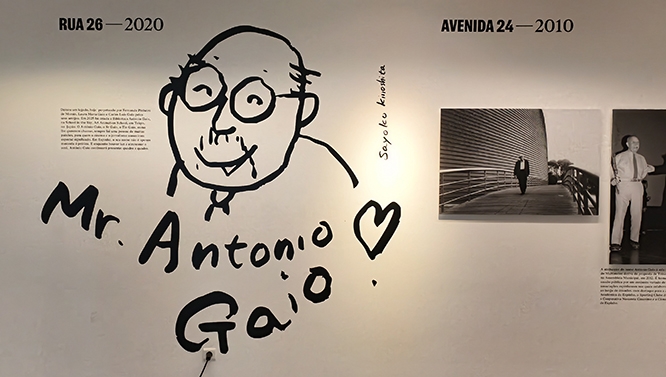
Tribute was paid to Antonio Gaio with an extensive exhibition in the theater lobby exhibition space. Photographs taken throughout his long life by family members and friends were on display. The exhibition and welcome drink marked the opening of the festival. It was followed by the opening ceremony, where we were given a further look into Antonio Gaio’s life with the 8-minute docu-animation film A Meeting of Collective Dreams.
In the film, directed by Marcello Santos Ferreira and Hugo Edgar Mesquita, animation was used as a way to fill in gaps in the archive of his life as well as to reimagine memories. Along with a portrait of a much-loved man, the film is a message to the next generation to “recognize the value of collectivism and culture as a force for transformation . . . to believe that cinema, animation and friendship can still bring people together, inspire communities, and give shape to new collective dreams”. These are beliefs that Antonio Gaio held very close to his heart.
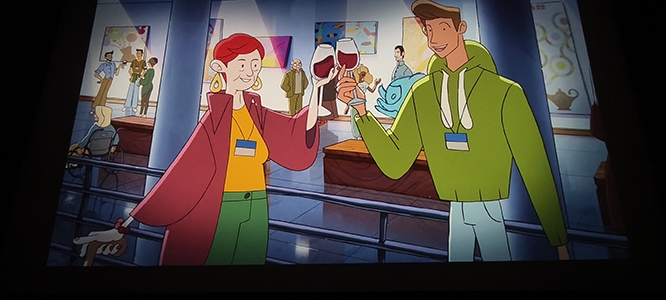
When the lights went down, and the trailer came onto the screen, I was surprised to see an animated me at a Cinanima party. The lovely trailer, titled Memories of Espinho, was developed and executed by students of the Animation Design Department course at the School of Technology, Management, and Design of the Polytechnic Institute of Portugal. The trailer began in an aquatic world where we are taken through the waters of memory when fishing was the main source of livelihood for the village. As we move into more recent times, the festival's animated images of members of the festival’s family made appearances on screen. It is a great honor for me to be included in this trailer, which so perfectly encompasses this year’s theme of memories and the future.
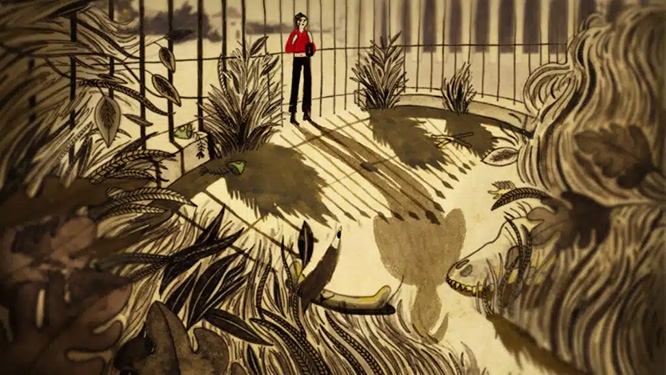
The competition programs were very strong. The Short Film Grand Prix was awarded to Marta Reis Andrade for her semi-autobiographical film Dog Alone. The beautifully animated Portuguese film is about loneliness, returning home to your family, and the plaintive howls of an abandoned dog. BAP Animation Studios produced the 13-minute film in co-production with lkki Films. I have written about this film in previous articles. Each time I watch Dog Alone, I find the story haunting, and it makes me wonder what would have happened to our sweet dog, abandoned on the street, if we hadn’t taken her in.

The award for Best Screenwriting was given to Because Today Is Saturday by Alice Eça Guimaraes. The Portuguese, French, and Spanish co-production is a film that every woman can relate to. Women worldwide, not just in Portugal, are most often still the people responsible for doing the unpaid jobs of housework, cooking, and taking care of the children, even though both people in the relationship hold down full-time jobs outside of the home. Because Today Is Saturday portrays one woman’s struggle with the difficulties of reconciling work, her homelife, and her need for some personal time on Saturday, which should be her one free day. It was no surprise to me that the film also won the Audience Award.
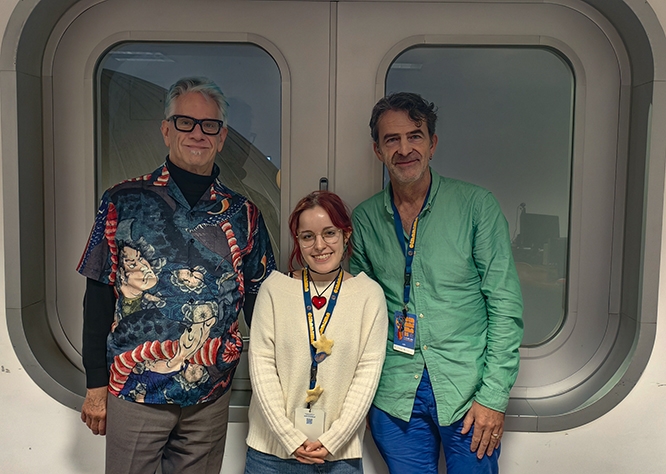
Nik had the honor to be on the Portuguese National Jury along with Adriana Andrade of Portugal and Menno Nooijer from The Netherlkands. Their award to a young director under the age of 18 went to Entre Pelos (Enter Hairs) by Feno Dias, Theo Quinhones, and Lucas Serra. Three women from different generations discuss their relationships with their body hair and the social pressure they feel to shave. The film shows how each of them deals with the subject and their right to choose how they look. Entre Pelos was developed by the students at the Universidade Lusofona, Centro Universitario de Lisboa, as part of the Animated Documentary program during the 2024-2025 academic year.
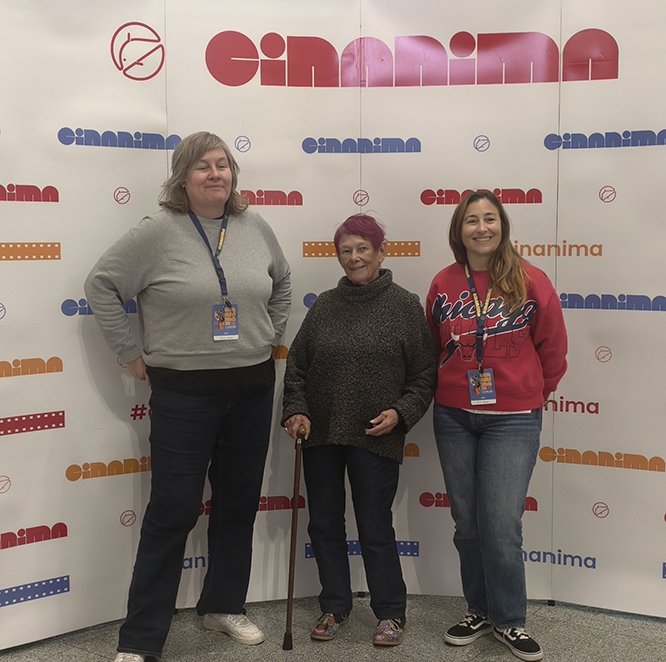
I had the pleasure of serving on the Feature Film Jury. My fellow jurors were Kajsa Ness of Norway and Julia Roche of Portugal. We had the pleasure of giving an award to Memory Hotel by German animator Heinrich Sabl. We also awarded a Special Mention to Hungarian Director Laszlo Csaki for Pelican Blue. These are both films that I like a great deal and have written extensively about in previous articles.
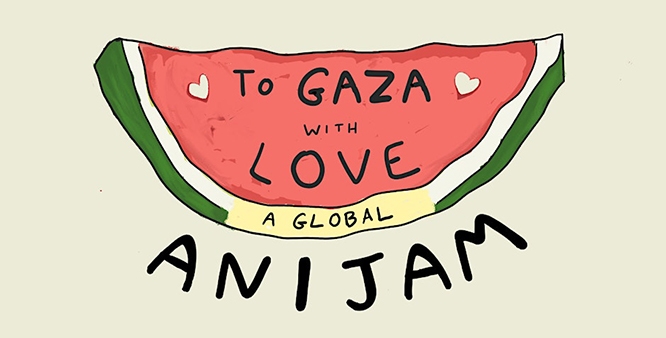
The 10 short films that made up the Palestine: Between Heaven and Earth screening were created by women and children living in Gaza. Under the leadership of Gaza City teacher and stop-motion animator Haneen Koraz, her students went from deprivation and being victims of the war to a feeling of power as they narrated their own stories with animation.
Inspired by Haneen’s work, To Gaza With Love is a global Anijam by animators from around the world. They created 10 to 30-second messages of love and support to the people of Gaza. Spearheaded by such major figures in the animation world as Joanna Quinn, over 350 short films were created by animators and artists from over 50 countries. One short a week was presented on YouTube. In September of 2025, a three-hour compilation was also shown on YouTube. A sampling of the To Gaza With Love films was also included in the Palestine program. New films are no longer being created, but you can see all of the films that were made at: www.togazawith.love
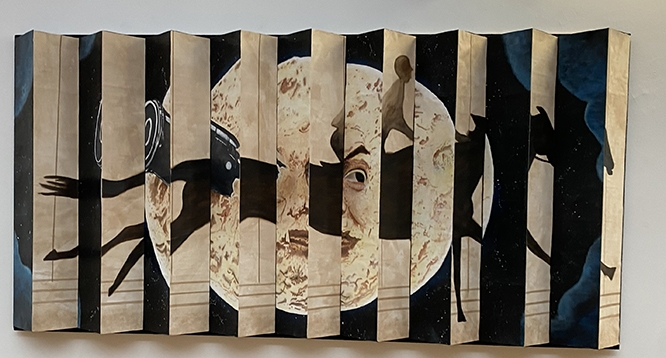
Noted animator and educator Pedro Serrazina was honored at the 5th edition of the festival’s Symposium Perspective on Portuguese Animation. 2025 marks the 30th anniversary of Pedro’s short film Tale About the Cat and the Moon. The film premiered at Cannes in 1996, won two awards at Cinanima that year, and has gone on to win many other prestigious awards internationally and is considered to be a classic animated film.
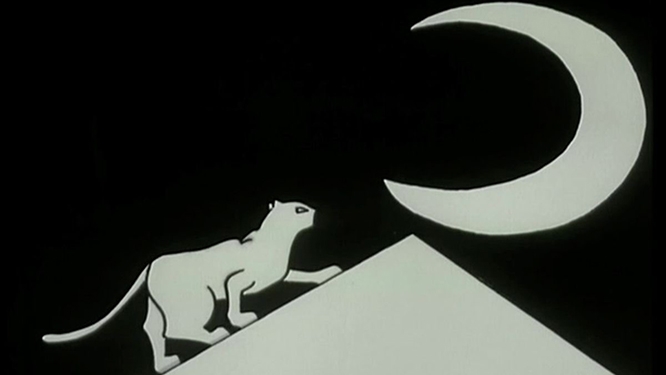
In stark black and white, the film begins with drawings of a black cat prowling over city rooftops. To quote Pedro, the film is “a poem. A tale of silence and complicity. Light and shadows, the charm of the night, the moon as a passion . . . This is a tale about someone who tries to make a dream come true. . .”
The haunting music composed and performed by Portuguese musician Manuel Tentugal lends just the right note to the film. Tale About the Cat and the Moon, a film about love, desire, and chasing a dream, is as timely now as when it was first screened.
To celebrate the third decade of its debut, a book has recently been published with the beautiful drawings and text from the film. Pedro presented the book at the festival.
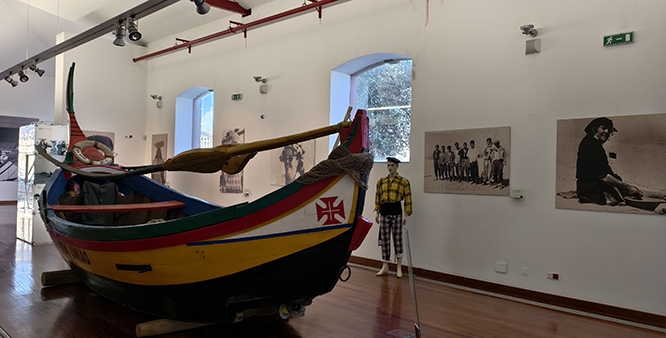
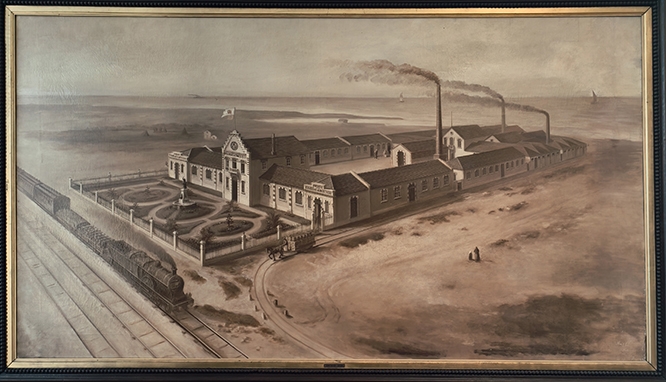
This year, some events were held in the Forum de Arte e Cultura de Espinho. The cultural center is housed in the one remaining building on the site of the old fish cannery. The downstairs houses an exhibition of artifacts and photographs of life at the cannery in the 19th and early 20th centuries. It gives a vivid picture of how Espinho was in the heyday of the fishing boats and cannery before tourism replaced fishing as the city’s main industry.
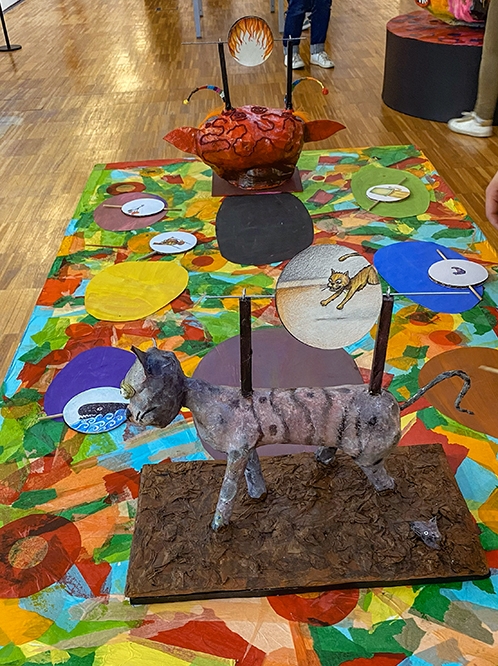
The spacious upstairs of the Cultural Center is devoted to exhibition spaces. This year, it was the site of the Anilupa Workshop Optical Toy Fair. The Anilupa Workshops involve young people and adults in all phases of the production of animated films and early optic devises. There were handmade replicas of versions of the 1880’s Praxinoscope, which uses a series of mirrors and still pictures to create the illusion of movement when spun.
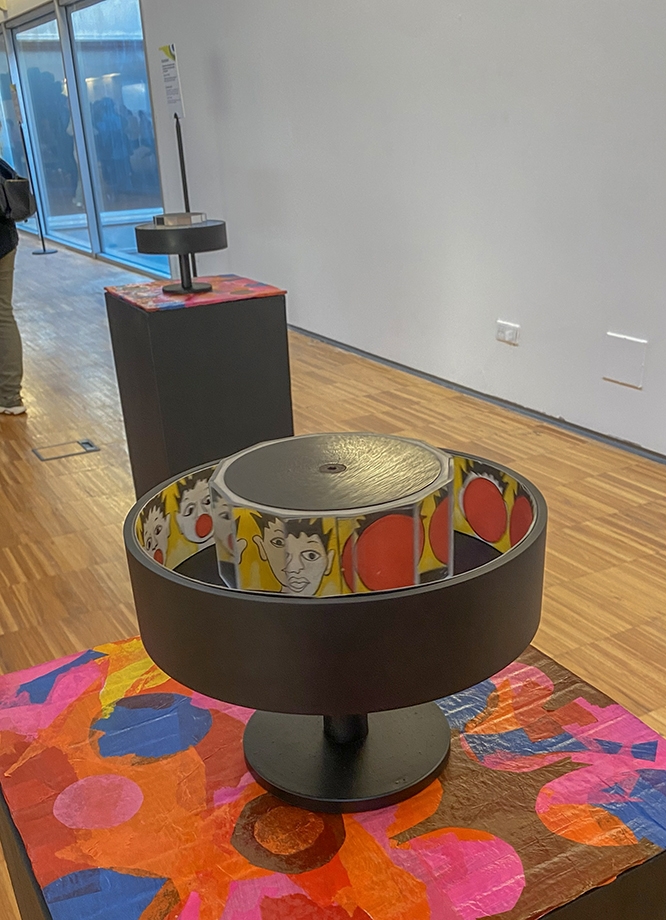
There were also zoetropes. A zoetrope is a topless drum with slits at regular intervals on the side. A series of images with incremental changes on them is placed inside the drum. When the drum is spun, and the viewer looks through the slits, the image appears to be moving.
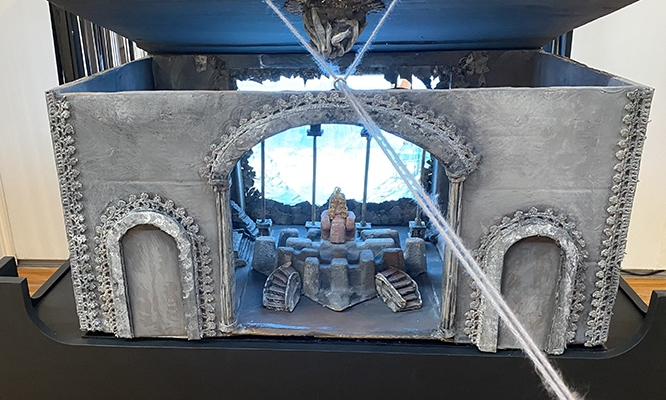
My favorite devices were the handmade zograscopes. It is an optical device for magnifying flat pictures that enhances the sense of depth in a picture. When you look into it, you see the picture in 3D.
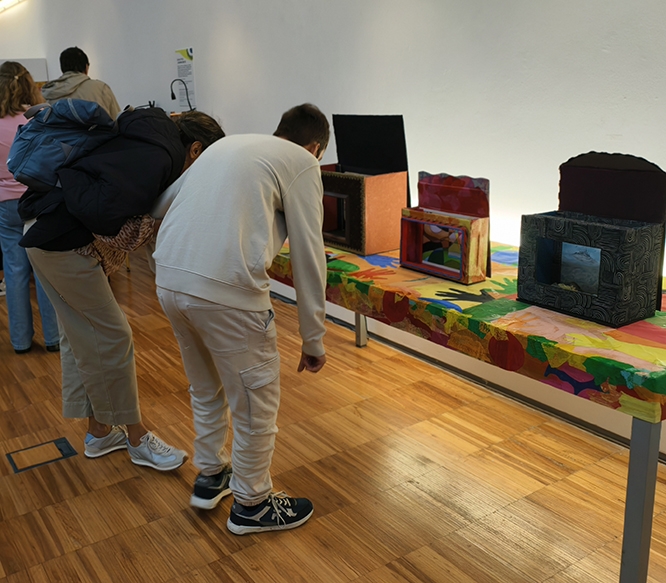
To make the exhibition was that every piece on display could be played with by the visitors. On the day that Nik and I saw the exhibition, there was a large crowd of people of all ages engaged in play.
New this year at the festival was the Anima VAM project. A mobile van was an experiment to bring a sense of community to outlying neighborhoods surrounding the center of Espinho through animation. People of all ages, from children to senior citizens, experimented with animation in workshops using stop-motion, pixilation, rotoscoping, and analogue cut-outs to tell stories about where they live, what they experience, and how they are perceived by the rest of the city.
The workshops, created by Anima VAM, in conjunction with the festival, not only helped to increase knowledge that animation is not just for children but can also be used to tell serious adult stories. There were also special animation screenings in the neighborhoods.
The Centro Multimeios Center, home to the festival, was constructed between 1998 and 2000. It is shaped to resemble a large fishing boat to pay homage to the fishing industry that was the backbone of the city’s economy for many years. The building houses a cinema with a screen that is 6 times larger than the standard size. Along with a café, the building is home to a planetarium. This year, in conjunction with NSC Creative, an arm of the National Space Center in Leicester, England, the festival presented two different 360° immersive cinema presentations in the planetarium. The Dark Side of the Moon – Pink Floyd set 10 tracks from Pink Floyd’s The Dark Side of the Moon album to visuals projected onto the top of the building’s dome. The visuals blended retro and futuristic themes tied to the album’s space and time themes. I enjoyed the show, but I thought that at 44 minutes it went on a bit too long.
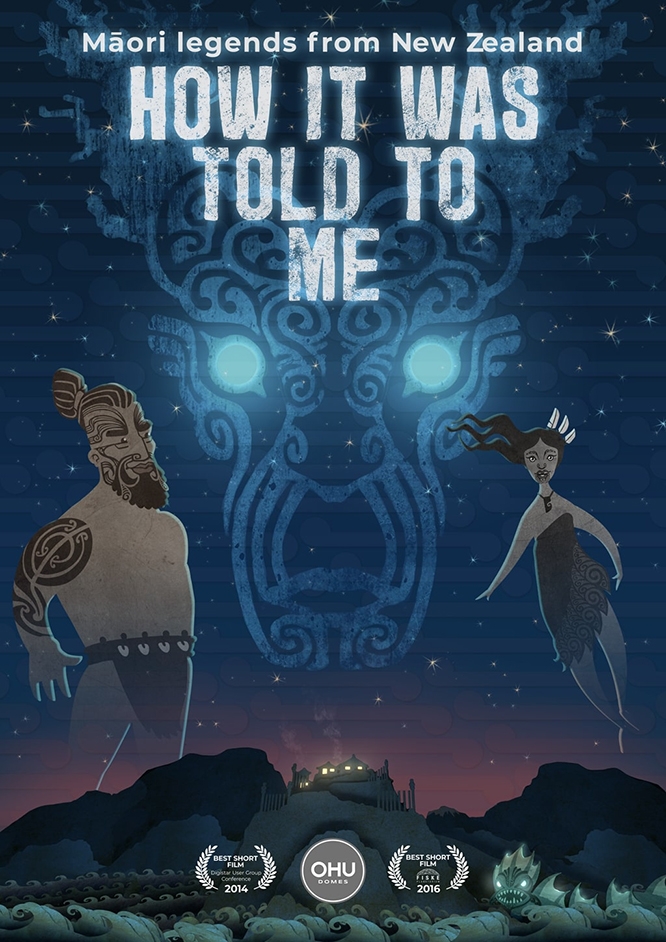
The second NSC program, How it Was Told to Me - Māori Legends from New Zealand, was a collection of three short animated films. The Creation Story tells the tale of Ranginu, the Sky Father, and Papatuanuku, the Earth Mother, and their many children who are plotting to separate the couple. The Great Waka is about the creation of the Milky Way with all of its constellations and how they have been used throughout the ages to guide Polynesian sailors who navigate the South Seas.
In Rona and the Moon, we learn about how Marama, the moon, came to look the way it does today in the Southern skies. The three pieces featured a soundtrack of traditional Maori music along with beautiful animation and fascinating storytelling. The entire three films totaled 17 minutes, but the program was so fascinating that the time flew by and left me wanting more.
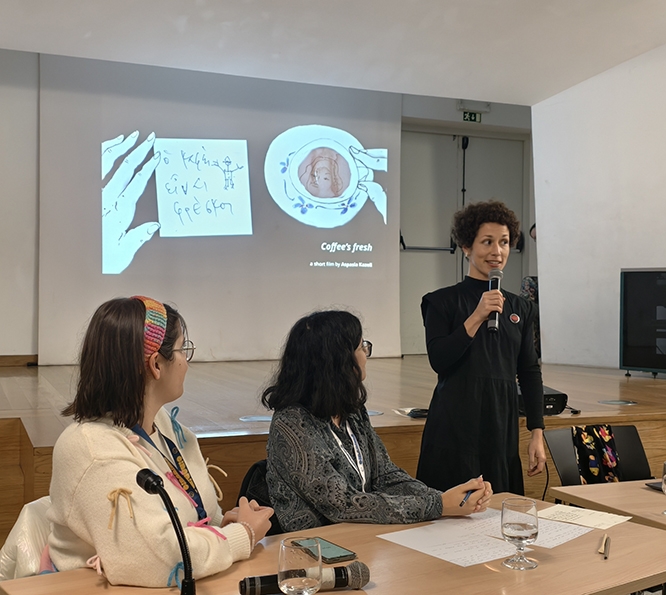
More and more festivals are making pitching sessions a part of their programs aimed at industry professionals. This year, Cinanima initiated two sessions of project pitching. They offered an opportunity for animators and directors to present their projects to an audience. It also offered a chance for animators looking for collaborators or particular skills to connect. For a first-time event, it all went quite smoothly. I am happy to hear that the pitching sessions will return next year.
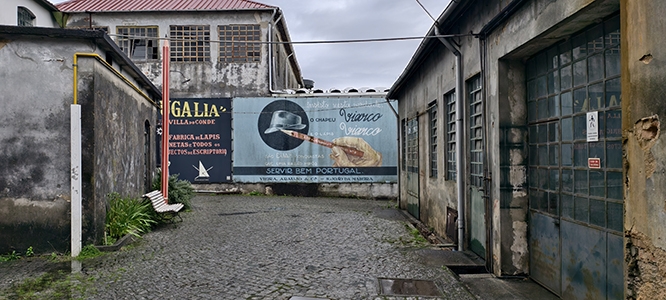
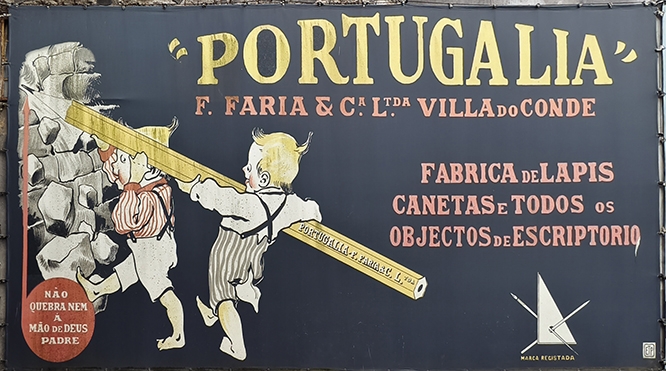
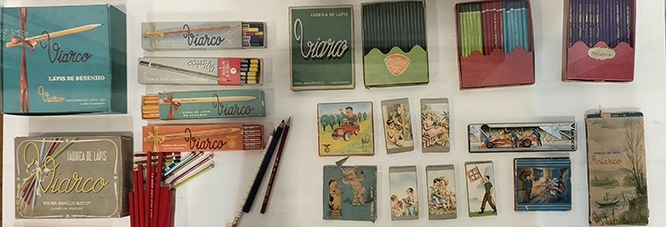
Each year there is are two special excursions. Over the years, I have visited a marble quarry, a rug weaving factory, and a paper making factory, to name some of the places I have visited. The excursions are always interesting. This year I learned all about how pencils are made at the 118-year-old Viarco Pencil Factory, the only pencil factory in Portugal. Located a few kilometers from Espinho in the town of San Joao da Madeira, the factory creates high-quality pencils primarily for the fine arts market.
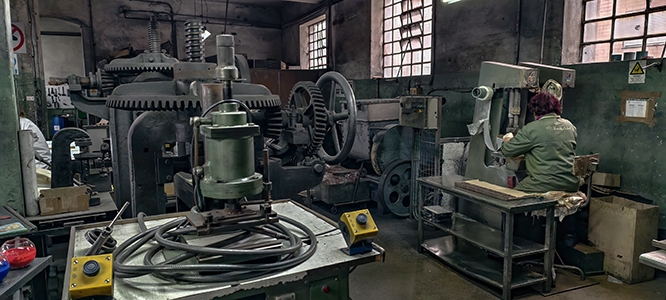
Instead of using cutting-edge technology to mass-produce their pencils, Viarco still uses equipment that was installed in the factory in 1941. The factory, now run by the great-grandson of the founder, uses meticulous care in creating its pencils. The final stages of finishing each pencil are done by hand.
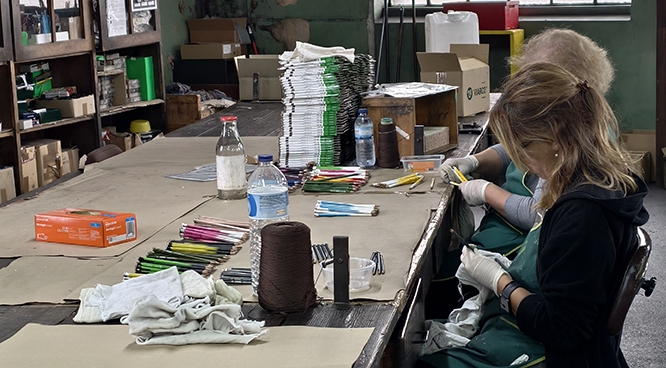
On the tour, we were told that the company can’t and doesn’t want to compete with large, mass production pencil factories but would rather create superior quality pencils for the arts, collaborating with designers, architects, illustrators, and artists to create high-quality pencils in a wide range of colors. Viarco pencils are available at such places as MoMA in New York City, MoMA Tokyo, as well as in fine arts product stores throughout the world.
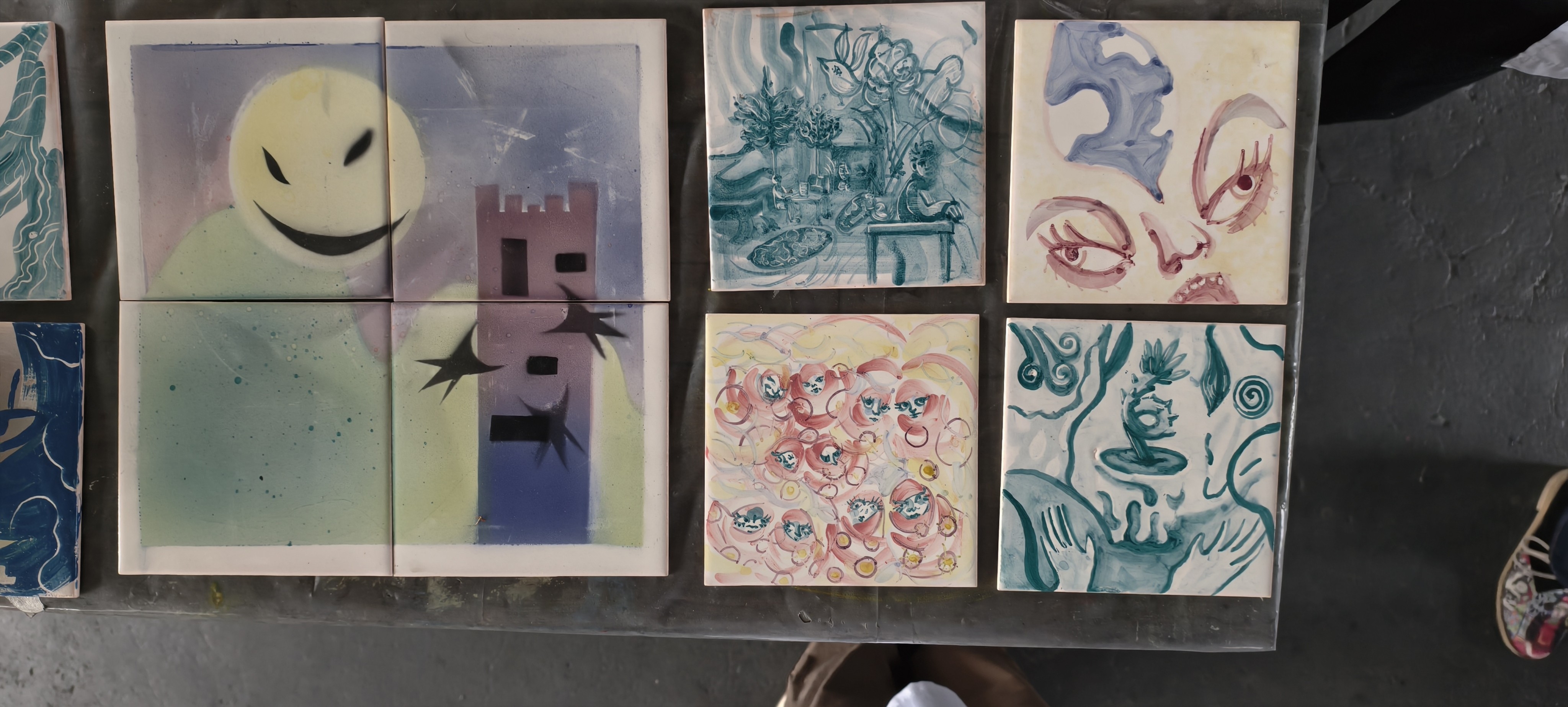
Viacro Pencil Factory also hosts an artists-in-residence program on the factory grounds. The company provides a large studio space and materials. The artists, who live in the studio, are not expected to produce any specific thing but are free to experiment with the materials provided for them in any medium that they would like. They also share their feedback about the materials, which helps the company in the development of new products. At the end of the tour, we were all invited to take as many colored pencils as we would like from the shelves and shelves of reject pencils, which were neatly stacked and separated by color. I have yet to figure out why the pencils I took were rejected, but I guess that level of quality control is why Viarco Pencils are so valued by the artistic community. When they say that they make perfect pencils, they mean it, down to the tiniest detail. I thoroughly enjoyed my visit to the pencil factory.
The 50th Anniversary of Espinho in 2026 will be a grand 3-week celebratory extravaganza. Running from 6 -22 November, the first two weeks will be devoted primarily to the Portuguese community. The festival will endeavor to bring animated cinema to segments of the country that are not often reached out to, with screenings that demonstrate animation is not just for children, and with programs for the entire family.
The last week of the festival, from the 16th to the 22nd, the festival will host foreign guests and the competition programs, along with many special surprises.
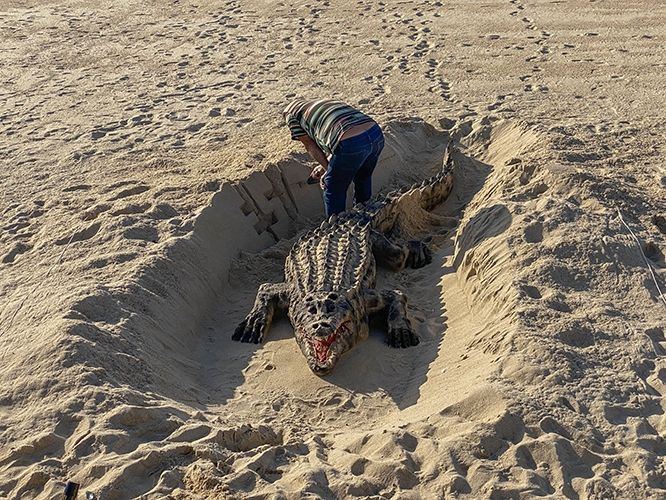
Cinanima prides itself on making its guests feel that they are part of the family, which is just one of the many reasons that I was delighted to be a member of the feature film jury this year. I am always happy to return to Cinanima, and it does feel like coming home to my family. A very warm, big thank you for everything she does goes to Cristina Lima, Head of the Guest Office, the Programming Department, and the person to go to if you need to know anything about the festival. I also want to thank the entire staff and volunteers who work so hard to make everything run smoothly and are always there to answer questions or offer help. I want to give a special thank you to festival staff member Henrique Praça, who arranges the fantastic excursions to fascinating places that I probably would not think of visiting on my own. He also comes along with us to make sure that we all get back to the festival without getting lost. I can hardly wait to find out where he is taking us next year.
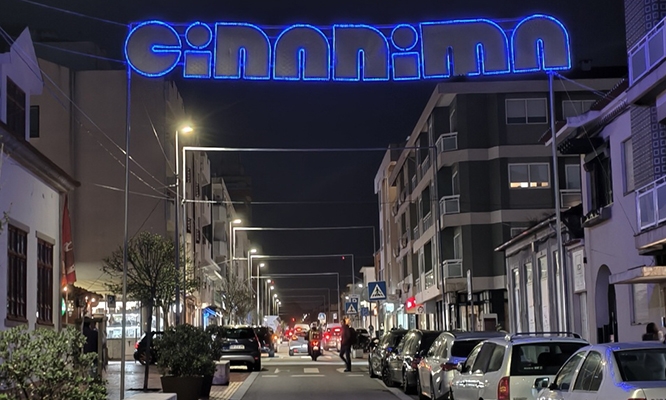
Save next year, 6 to 22 November, to be part of the 50th Anniversary extravaganza!
You can learn more about this year’s event and how to submit your film to the next edition at: www.cinanima.pl
THE WINNING FILMS AND JURY MEMBERS:
SHORT FILM JURY: Agnes Adomene -Lithuania; Kasper Jancos – Estonia; Leonel Vieira – Portugal; Lucija Mrzljak– Estonia; and Steve Woods – Ireland
SHORT FILM GRAND PRIX: Dog Alone, Marta Reis Andrade – Portugal
JURY’S SPECIAL AWARD: Bus, Sylwia Szkitadz – Belgium, France
BEST SOUND DESIGN: Hurikan, Jan Saska – Slovakia, France
BEST SCREENWRITING: Because Today Is Saturday, Alice Eça Guimaraes – Portugal, France, Spain
BEST ART DIRECTION: Society of Clothes, Dahee Jeong – Canada, France, South Korea
COMMENDATION FOR SHORT FILMS: Water Girl, Sandra Desmazières – France, Netherlands, Portugal ALL ABOARD Jury: Marcio -Portugal, Ricardo Riscas – Portugal, and Sofia Faria -Portugal
FOR ORIGINALITY? CREATIVE RISK? AND AUTHORIAL IDENTITY: As If The Earth Had Swallowed Them Up,
Natalia Leon - France
FEATURE FILM JURY: Julia Rocha – Portugal, Kajsa Naess – Norway, and Nancy Denney-Phelps – Belgium
BEST FEATURE FILM: Memory Hotel, Heinrich Sabl – France, Germany
FEATURE FILMS SPECIAL MENTION: Pelikan Blue, Laszlo Csaki – Hungary
STUDENT FILM JURY: Bruno Caetano - Portugal, Georges Sifanos - Greece/France, and Luca Toth -
Hungary
BEST STUDENT FILM: Between The Gaps, Martin Bonnin – France
STUDENT FILM SPECIAL MENTION: Winter In March, Natalia Mirzoyan – Estonia/France
STUDENT FILM SPECIAL MENTION: Swallow’s Tnada, Daniela Godel – France
NATIONAL COMPETITION JURY: Adriana Andrade – Portugal, Menno Nooijer – Netherlands, and Nik Phelps – Belgium
ANTONIO GAIO AWARD: Wildflower, Carina Pierro Corso – Portugal
SPECIAL MENTION FOR NATIONAL COMPETITION: Saudade, Talvez, José-Manuel Xavier – Portugal
YOUNG PORTUGUESE DIRECTOR AWARD (18 TO 30 YEARS OLD): Entre Pelos, Feno Dias, Theo
Quinhones, and Lucas Serra – Portugal
YOUNG PORTUGUESE DIRECTOR (UNDER 18 YEARS OLD): O Desafno De Joana, Associaçao de Ludotecas
Do Porto/4° Ano de Antas – Portugal
AUDIENCE AWARD: Because Today Is Saturday, Alice Eça Guimares – Portugal, France, Spain