I was looking forward to seeing what life was like on this island so close to mainland China
So Near and Yet So Far
I have been to China 13 times, visiting animation festivals and conferences in various cities, so when Nik and I were invited to Taiwan to participate in the Kuandu 15th International Animation Festival, I was looking forward to seeing what life was like on this island so close to mainland China. Taiwan is separated from China by the Taiwan Strait, about 180 kilometers (112 miles) wide at its broadest point. The mainland and the island are so near and yet so far apart.
During my visits to China, I was always given a handler who stuck to me like glue - I was not allowed to go anywhere on my own, with everything planned out for me. I had lots of pictures taken of me with officials, was taken on visits to many animation schools, and I ate at numerous fancy banquets. I saw almost no animation. Everyone was very nice and polite, but aside from my handlers, none of whom were animation students, I didn’t actually get to meet any animation students long enough to have a conversation with them.
In Taipei, Nik and I were given assistants who ARE animation students at the university where the festival was held. They were there if we needed something, but were not there from the moment we got up to when we were tucked into bed. We were free to go anywhere we wanted to go alone as long as we were at the cinema on time for our scheduled events.
The week of the festival was very busy. My main presentation was a one-and-a-half-hour talk on The Unsung Women Heroes of Animation. We all know Lotte Reiniger, whose silhouette animated film, The Adventures of Prince Achmed, will celebrate the centennial of its creation this year, but who recalls Lillian Friedman Astor, who was hired by the Fleischer Brothers in 1933? Originally hired as an inbetweener, she went on to become the first female studio animator to receive a screen credit for Pudgy and the Lost Kitten, a 1938 Betty Boop film. Lillian was only credited with 6 of the 11 films that she worked on at the Fleischer Brothers Studio.
It isn’t just early female animators who have gone unnoticed. Brenda Banks is one of the first African American animators working in the industry. She worked on Ralph Bakshi’s Wizards in the1970’s and went on to animate on The Simpsons, Virtual Springfield, and served as a character layout artist on The Simpsons show. She also worked on The Smurfs, King of the Hill, and was a key animator on The Lord of the Rings.
After my presentation, it was very gratifying to be surrounded by young female animation students who asked me questions and wanted to know more about the history of women in animation. One young lady told me that she is a first-year Master’s Student and researcher who is still trying to find her path in animation. She said that she would also like to do research into the history of women in animation and asked me if I had ever done any research into Asian women in animation. I told her that I had not, but that it would be a good topic for her thesis.
Nik gave a lecture on Toons and Tunes in the cinema. During his presentation, he traced the history of animation through music screening such films as Anthony Gross and Hector Hoppin’s Joie de vivre (1934) and the 1936 Page Miss Glory directed by Tex Avery.
At the university’s music department, Nik also gave a two-hour workshop titled Sync or Swim. He discussed the timeless principles of integrating music with film, tracing the evolution of scoring techniques and exploring how modern innovations have refined and streamlined the creative process. Covering such topics as how our brains process audio and visual information, he also traced the technicalevolution of putting sound and music onto film, talking about how these innovations transformed storytelling and streamlined the craft of sound design and soundtrack scoring. He then curated a screening of his favorite animated films—each a masterwork showcasing the seamless fusion of sound and visual storytelling.
Founded in 2011, the Department of Animation at TNUA is one of Taiwan’s few institutions dedicated solely to professional animation education. The first animation festival was held at the school in 2011. Unlike most international animation festivals, KDIAF has, from its very beginning, been organized by both the faculty and students. In 2013, the festival initiated an international competition, which received over 300 entries. This year, the festival had 2,400 submissions from 104 countries. The festival has become a truly international event.
This year’s theme was Animation’s 15th Dimensional Journey. The opening ceremony began with a trailer that featured a dog like Laika on a fantastical voyage across multiple universes. Laika was the first living creature to be launched into space. Unlike Laika, who probably died a horrible death, the festival dog travels to outer space in a spaceship where she discovers a vast sea of flowers on a lonely planet. She runs joyously beneath the sparkling stars through fields of flowers. Unlike most trailers that I get pretty tired of watching by the end of a festival, I looked forward to seeing the adorable dog on screen. The trailer was created by five students at the school.
The trailer was followed by 9 short films created by members of the 2nd year Master’s Program. They were completed in just one month and showed distinctive styles and narrative approaches.
The 1st year Master’s Program film screening was followed by 43 ten-second looping films created by students using basic animation programs. The young students collaborated with 1st year students in the music program who created the original soundtracks.
I was quite impressed with all of the students' work and expect to see some excellent animators from the Taipei National University of the Arts. Beginning with the trailer and running through both student programs, I did notice dogs featured in a great number of the films, which I definitely consider preferable to big-eyed, snub-nose girls and robots.
The opening night feature film, The Songbirds’ Secret, is the first feature film directed by the noted French screenwriter, storyboard artist, and animator Antoine Lanciaux. It is the story of 9-year-old Luce, who, guided by a pair of birds and accompanied by her new friend Yann, uncovers a family secret on her vacation to Bectoile, the town where her mother grew up.
Lanciaux is best known as the co-screenwriter of Raining Cats and Dogs and an animator on A Cat in Paris. He used over 2,000 paper cutouts to tell a story that can be enjoyed by both children and adults. The visuals are lovely, and the story of a young girl’s search for the truth about her family’s hidden past is delightful.
I had the pleasure of being on the International Jury along with Waltraud Grausgruber from Vienna. She is co-founder of Tricky Women, Tricky Realities, an organization that is committed to giving female filmmakers a greater voice and more visibility in the film and animation industry. The third member of our jury was Cécile Blondel. She is the Director of International Development at the prestigious university Gobelins, where she also oversees the Summer School and Master’s Program in International Storytelling.
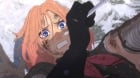
We awarded Florence Mialhe’s poignant, beautifully painted on glass Butterfly the Best Animated Short Film Award. The film, which I have written about before, is currently on the Oscar Short List of 15 films.
We selected The Undying Pain of Existence by German student Oscar Jacobson as the Best Student Film. The humorous film is about a male nude model who is posing with statuesque stillness for an elite drawing class, until a pesky mosquito bites him in a most unfortunate place, and his self-control is put to the test. Driven to madness by the itch, the model is caught between his ruthless demand for perfection and his most unhinged, animalistic impulse to itch. The Undying Pain of Existence was a finalist at the prestigious Student Academy Awards, which are presented by The Academy of Motion Picture Arts and Sciences. To be selected as a finalist is considered a great honor, and this film is not just humorous; it’s also well-made.
I had seen many of the competition films before; I had not seen Melon by Taiwanese animator Chen Zhi Yi, and I was impressed not only by the story but also by the beauty and skill of her drawings. The title of the film refers to a society where thought is tightly controlled. Children within the Asian educational system are taught from a young age to become “perfect melons”, obedient, quiet, and indistinguishable from each other. Chen Zhi Yi uses the metaphor of a watermelon to explore how conformity is instilled and individuality erased. Her 2’20” film reflects on generational conditioning and questions whether a person can still have an individual personality under such strict conditioning to create conformity.
Our jury also selected the Best Taiwanese Student Film. That award went to Chuang Yu-Jin for Falling Mist. The film is a beautifully animated contemplation piece. During a drive home from work through the busy city to a desolate industrial road, the driver ponders the end of life and her deep reverence for all living beings.
I also liked The Peel a great deal. Taiwanese student Nan Tung Lin focuses on human emotions, translating feelings onto the screen with handcrafted frame-by-frame animation. After a flat tire leaves a woman stranded in the woods, she revisits haunting memories of her self-destructive tendencies. As she peels the skin from her fingers, each strip draws her deeper into the past. With every layer, she steps closer to revealing the hidden child within herself.
Nik was on the Music Score Jury. They gave their award to a film that spans three different periods of a relationship between a father and son. Parallel by Taiwanese student Yu-Hao Li moves between distance and closeness, like parallel lines, in their relationship over a number of years.
The jusy noted the effective use of string orchestra to highlight the emotional experience of the battles involved in a father-son relationship
Along with the numerous competitions and special screenings, festival guests gave presentations. Cécile Blonder talked about Gobelins Paris and showed an excellent selection of films by its students. One of the interesting things about films produced at Gobelins is that they are not directed by just one or two students, but usually by four or five different students credited as directors. The school’s students consistently turn out very polished, high-quality films. The Shyness of Trees, directed by Sofia Chuikovska, Loick Du Plessis D'Argentré, Lina Han, Simin He, Jiaxin Huang, Maude Le Bras, and Bingquig She is currently on the 2026 Academy Award Short List. Cécile showed the film about the relationship between a mother and daughter as the mother sinks deeper and deeper into her own world.
Co-founder of Tricky Women, Waltraud Grausgruber, showed a selection of films from previous Tricky Women Tricky Realities Animation Festivals. Launched in 2001, the festival takes place annually in March around International Women’s Day. It presents works by women and/or gender queer artists in theatres across Vienna, as well as reaching a global audience online.
Savannah College of Art and Design was the school that was in the spotlight at the festival this year. The private, accredited university offers more than 100 graduate and undergraduate degree programs at its campuses located in Atlanta and Savanna Georgia, and La Coste France. The school was represented by Davonne Dupart, Associate Chair of Animation at the school. She presented a program of films by students from the college.
Anyone who has been involved in animation for very long is familiar with Max Hattler’s abstract films. The German-born experimental animator and visual artist has been active in the field of abstract animation for over 20 years. For the past 10 years, he has been based in Hong Kong, where he is a tenured Associate Professor at the School of Creative Media, City University of Hong Kong.
Although experimental and abstract animation are not my areas of expertise, I am a fan of Max’s work. His film program began with his 2005 kaleidoscopic political 3-minute film Collision. Islamic patterns and American quilts mix with the color and geometry of flags to create an abstract field of reflections.
The first time I became aware of Max and his work was in 2010 when I saw Spin. For almost four minutes, toy soldiers march and move, spinning and rotating, erupting, and exploding. His film shows what happens when conflicts become a spectacle and the lines between destruction and entertainment become blurred. I have seen Spin a number of times, and it still has a strong impact on me. Given the state that the world is in today, the film is as relevant now as when it was made.
The last two films in the program were films that I also like a lot. Using Hong Kong’s distinctive masses of high-rise apartment buildings, Max reimaged them as parallel rows of film strips. The 9-minute Serial Parallels approaches the city’s environment from the conceptual perspective of celluloid film by applying the technique of animated film to photographic images of different apartment buildings placed side by side on the screen.
Max has an interest in the relationship between sound, music, and the moving image as his 2023 film O/S (5.00’) demonstrates. The film is inspired by 20th-century avant-garde experiments in graphical sound generation. The entire image of O/S functions as an optical soundtrack. Abstract motion becomes sound. What you hear is what you see.
The festival catalogue contained an Animation Research and Practice section where theoretical and research papers were printed. The papers ranged from When Creation No Longer Belongs To Humans: The Future of Visual Art and It’s Moral Boundaries by Cheng Chen-Kai, member of the Department of Animation at Taipei National University, to The Transcendent Appeal of Stop Motion Animation by Professor Wang Chi-Sui. My contribution was a nine-thousand-word paper on The Cross Roads of Animation and Documentary Films.
The closing awards ceremony was followed by a screening of the Japanese film ChaO by director Yasuhiro Aoki. I had seen the film a week and a half before at Etudia & Anima. As I said in my article about that festival, it is an interesting and unique take on Hans Christian Andersen’s The Little Mermaid. The film is well worth seeing.
Nik and I were lucky enough to arrive 6 days before the festival began, and we also stayed in Taipei for 5 days after the festival ended, so we had a lot of time to explore the city. One day, Festival Director Joanne Chao took Nik and me to visit stop-motion director Hugo Huang at her Rotating Rhino Studio. Born into a family of traditional Taiwanese dough figurine artisans, she has been crafting handmade stop-motion films for 19 years, combining traditional dough craft with animation. Her short films, such as Little Hilly and My Name Is Pai Pai, blend local culture with delicate storytelling dealing with such topics as depression, the value of cooperation, and growing up. Her short film Little Hilly (2020) won Best Animated Short at the Los Angeles International Short Film Festival, which qualified it for Oscar consideration that year.
Hugo is currently at work on Taiwan’s first stop-motion feature film. Although the script is still in development, we saw some of the elaborate sets and puppets for the upcoming production. Joanna Chao has stepped down as director of the KUANDU festival to work full-time on the script for the film. It was lovely to see the beautifully crafted sets and puppets and to meet several members of the animation team.
After our tour, Hung and members of her team treated Nik and me to a lovely lunch at a nearby restaurant specializing in everything duck, a wonderful afternoon was spent savoring many dishes. A very big thank you to Hugo and her team for their warm welcome and for taking the time to tell us about their upcoming production and answer all of our questions. Hugo also gave us beautifully illustrated books based on her films Little Hilly and On Being One Person. On the drive back to Taipei, Joanna took us to a traditional foot bath. It was a great treat to soak my feet in the hot water, outdoors under spreading shade trees.
The Taipei National University of the Arts has a beautiful campus. Located on 40 hectares (approximately 98.8 acres) of trees and grass, the campus has numerous walking paths. The building also boasts some lovely architecture. There is also a small herd of water buffalo that roam freely and “mow the grass”. It is an idyllic setting for an arts university.
Our luxurious hotel was within walking distance of the historic Beitou Hot Springs area. You enter the area through a lovely park with a covered area that has tables for Mang Jong playing. The park is home to Taiwan’s first green-built library. The roof is made of lightweight echo material set with solar panels. The green roof and sloping turf around the building drain rainwater into tanks for use in irrigating the surrounding grounds. The architecture of the ship-shaped library is beautiful.
As you walk up the gently sloping tree-lined sidewalk, you come to the Hot Springs museum, where you can learn about the geological make up the area, along with historic information about the entire area. There are also photographs of the original hot springs public bath built in 1913. It is a Japanese-style wooden structure with outdoor bathing pools. It was the largest public hot springs bathhouse in East Asia when it was built.
Unfortunately, the original Beitou Hot Springs was closed for renovations and won’t reopen until February of this year, so we didn’t get to sample the water there. Numerous hotels in the area offer bathing pools with a choice of either private room and public baths, ranging in amenities and price from basic to very luxurious and expensive.
As you continue up the hill, you reach the Beitou Thermal Valley. It is one of the” sources supplying the area’s hot springs. As you walk on the wooden bridge around the steamy pool, sulfuric steam wafts up your nostrils. Right outside of the steaming pool is an area with a nice little café with cold beer and hard-boiled eggs steamed in hot springs water. The eggs do have a slightly sulfurous taste to them.
Wherever we are in the world, when we see a sign advertising Mexican food, we have to try it. Some of the best, most authentic tasting that we have found has been, surprisingly, in Edinburough Scotland, and Lucerne, Switzerland, but what we discovered in the Beitou Valley is some of the best we have found anywhere outside of Mexico.
A small bar and café just up the road from the entrance to the Thermal Valley had delicious tacos. Their tortillas were cooked to perfection, not too hard and crunchy, not too soggy, just perfect. My pulled pork taco was expertly cooked, and the salsa had just the right amount of heat. It was a lovely surprise!
Near the entrance to Beitou Park is the indigenous people’s museum, Ketagan Cultural Center. We learned that there are around 2,000 indigenous people still living on the island up in the mountains. Built in 2002, the center is dedicated to preserving the history, traditions, and cultural practices, and preserving the various indigenous, distinct traditional languages of the now Han Chinese majority speaking residents of the island. It is a fascinating museum where I learned a great deal about the early inhabitants of Taiwan.
In our wonderings we discovered many wonderful things, including street murals, a bookstore that turns into a bar at night, and the market district. I developed a great appreciation for Taipei and want to return. There were so many fascinating things to still be discovered, not to mention delicious food to eat. I ate many wonderful dumplings, which are a favorite of mine. The people were also so warm and welcoming.
I want to thank Joanne Chao for inviting Nik and me to be part of the Kuandu International Animation Festival and for the warm, gracious hospitality she and the festival gave us. We also owe a debt of gratitude to our wonderful assistants Ann Chu, Selena Lai, and Roxy Lin. They were fun to be with and very patient with us. We left Taipei with so many lovely memories. From there, we flew straight to Espinho, Portugal, for Cinanima.
You can read more about the festival on their website at:
https://kdiaf.tnua.edu.tw/web/about/about_01.jsp?cp_id=CP1744116709328&lang=en
List of winning films (email from Joanne Chao on January 2, 2026