
VFX Supervisor Sheldon Stopsack and Animation Supervisor Karl Rapley detail the expressive facial animation breakthroughs on the badass Predator Dek, the challenges of conveying his emotions, plus how they created lethal vegetation and a huge regenerating monster, on 20th Century Studios’ hit ‘Predator’ franchise outing, debuting today on Hulu and Hulu on Disney+.
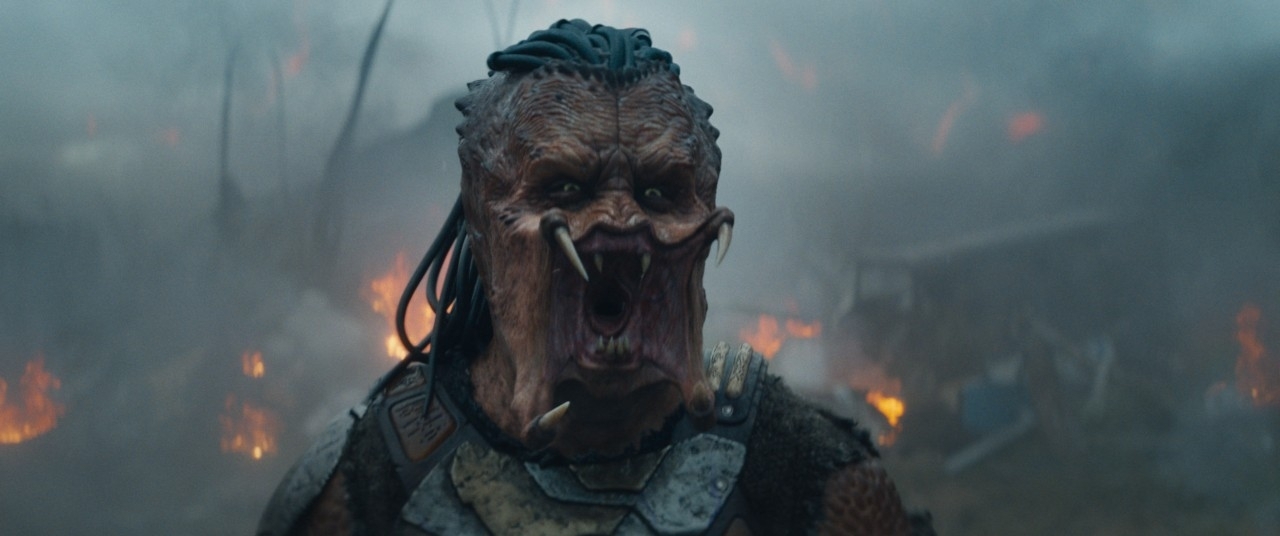
Hitting Hulu and Hulu on Disney+ today is the latest Predator franchise cinematic outing, Predator: Badlands. In the films, the extraterrestrial hunter, this time a young Yautjia named Dek, forms an alliance with an android named Thia in an effort to survive the hostile wildlife and armed, environmental exploitation of the Weyland-Yutani corporation on the planet Genna. The hit science fiction action film, directed by Dan Trachtenberg, features the creature design talents of Alex Gillis and the digital expertise of Olivier Dumont. Leading VFX company Wētā FX contributed 560 shots that focused on creating emotive facial animation for Dek, executing a massive creature known as the Kalisk, and producing the third act battle finale between Dek and Thia’s android counterpart Tessa.
“Predator: Badlands is very different from any other Predator movie that we've seen so far, and that obviously set the table in many ways,” states Sheldon Stopsack, Visual Effects Supervisor, Wētā FX. “The Predator is the protagonist, which is such a bold decision from a filmmaker’s point of view… to approach it from a different angle. Right from the get-go we knew we were in for a ride with the creation of Dek and every aspect of the work that required. There was a lot of lead-up time where discussions took place about how to approach Dek as a character. Obviously, there was a strong desire to honor the legacy of the franchise. Early tests were done with the more traditional approaches of puppeteering and animatronics. It became clear with the new lead role this Predator was taking that we had to take this further. We had to engage with visual effects and computer graphics to give Dek the emotional depth he required to service all these different needs in his journey.”
Expanding upon the iconic creature design was the Wētā Workshop. But the modifications and fine-tuning did not end there. “The film hinges on whether we relate to this Predator, a character that has been built-up over the history of the franchise as the ultimate badass, but also very intimidating,” remarks Karl Rapley, Animation Supervisor, Wētā FX. “We had a great performance from Dimitrius Schuster-Koloamatangi to anchor everything on. Then we had our creature, which obviously has mandibles and no lips. We have these cheeks and a big larynx that were alien to look at. Take all of those and through a long process find our range. You keyframe the whole performance after taking what the actor was doing and translating it by observing, studying, and finding our rules for Dek. But the rules also had to be quite flexible because they could change shot by shot. We were looking at each aspect of the performance. With CG you can do everything. So, we had to pull ourselves back and find the right range that would give a good performance without over performing or doing something that would seem off to an audience.”
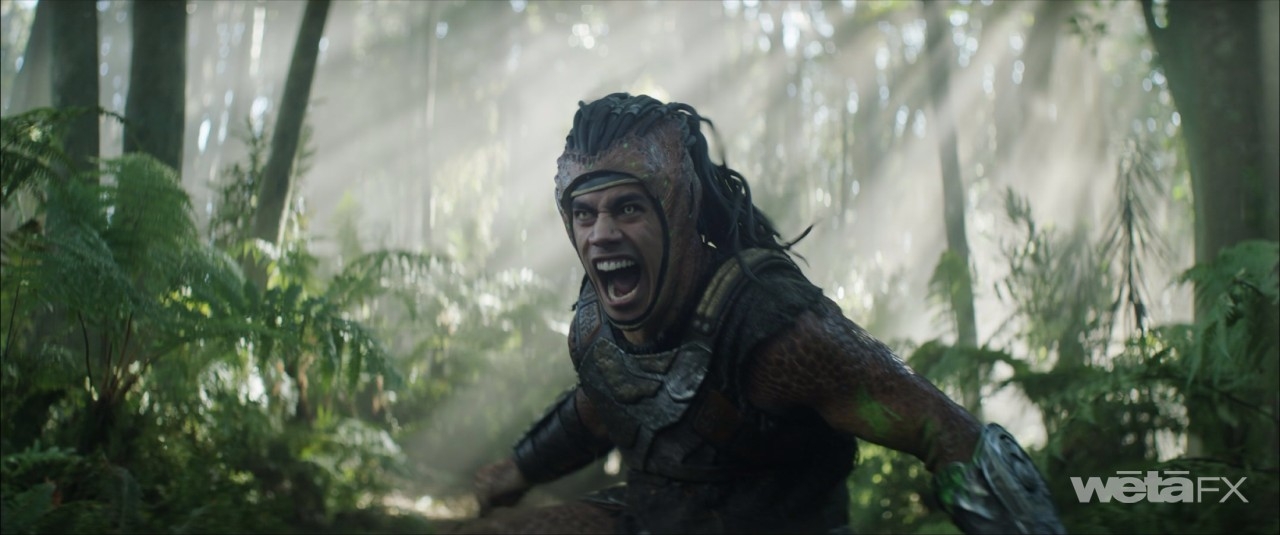
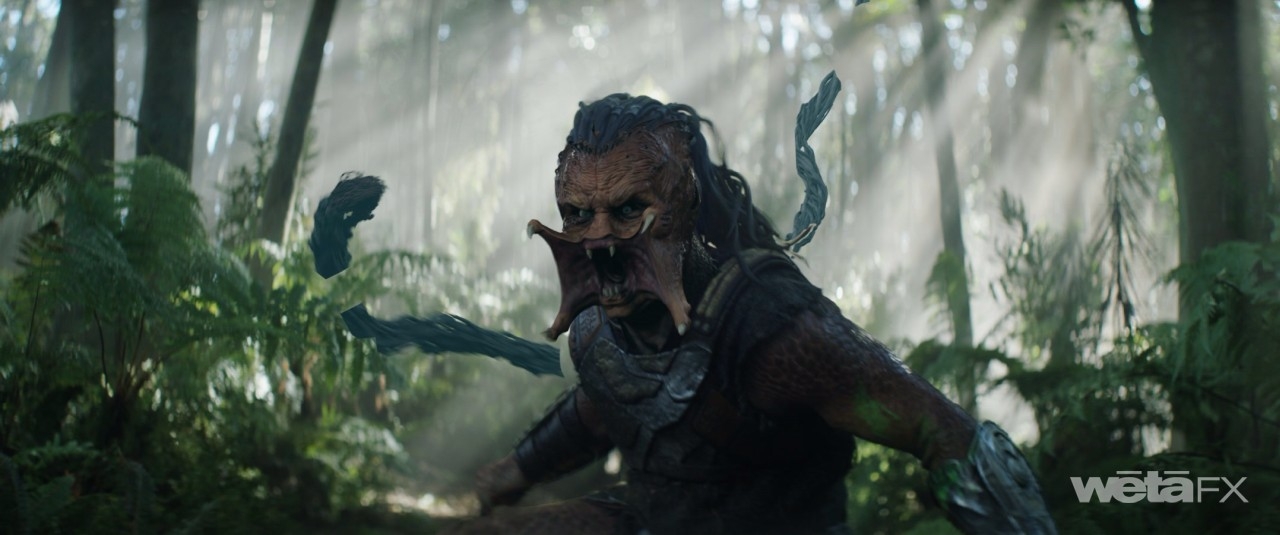
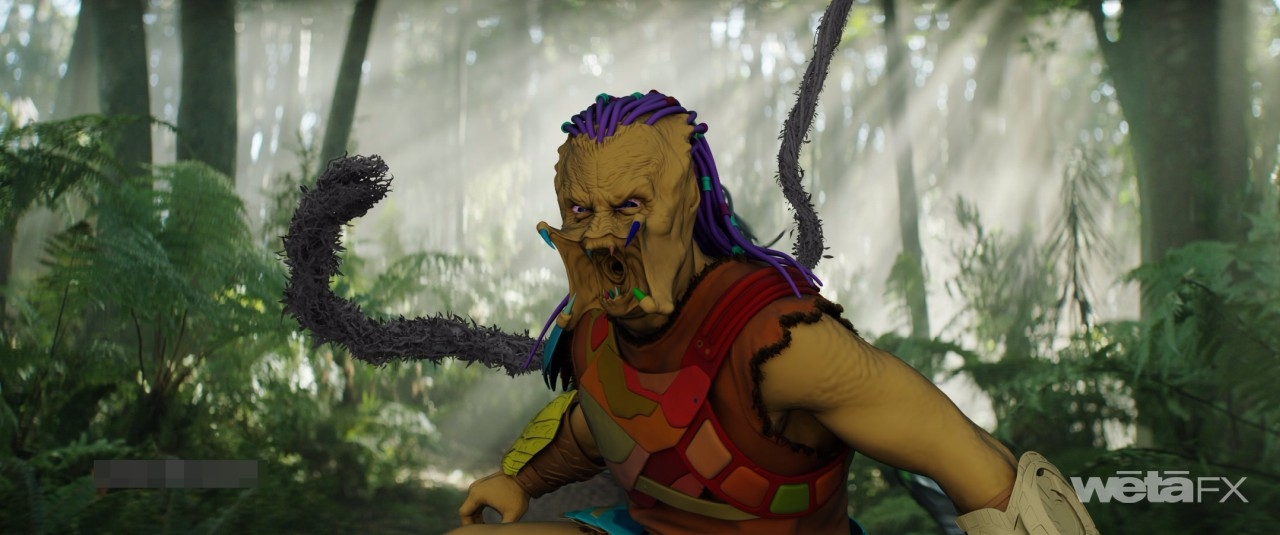
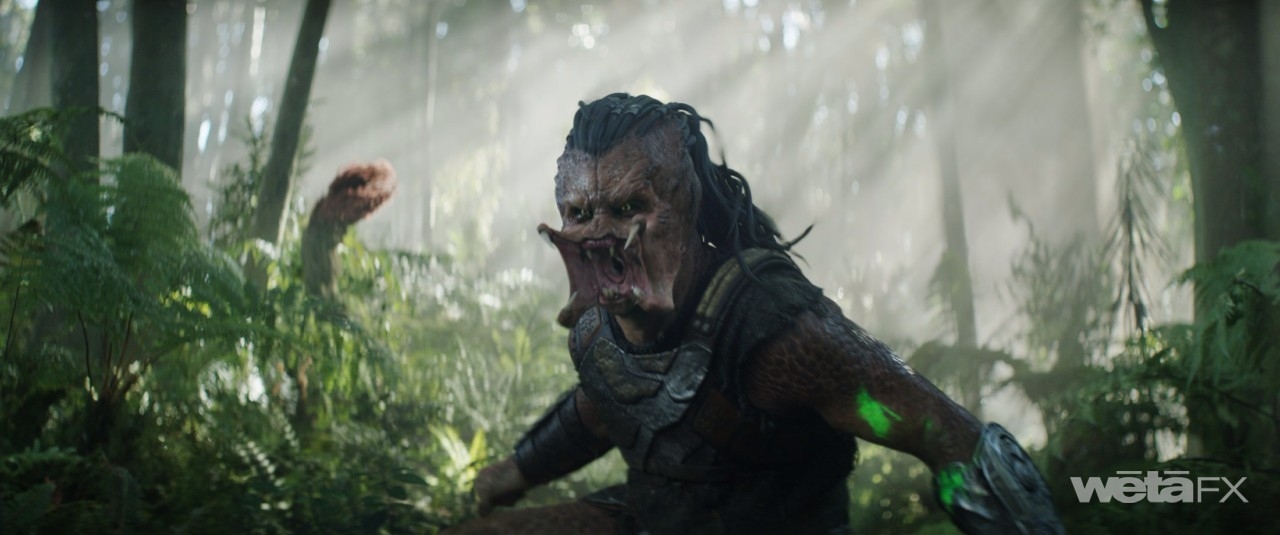
One big challenge was how to accommodate dialogue and certain facial movements for Dek. “When we talk, we close our lips, which Dek can’t do,” explains Rapley. “He can close his jaw, but the teeth stop. We were experimenting with the teeth. Are there gum areas where they can slide into so the mouth can actually close? That didn't look any good. It's finding those analogues so the audience can make the leap because we're so used to seeing a smile on a human. How do we make Dek smile? You raise his mandible up here, try to crinkle the eyes, and have the cheek raise on this side. You can bridge the gap and find an emotion that you can connect with.”
In the end, Dek’s eyes were done entirely in CG. “The eyes are something the audience will always go to first, so they needed to work,” notes Stopsack. “We're always going to look at him as a character that you can relate to because of the fact that you have these eyes. Obviously, aesthetically, and stylistically, decisions were made not to make them too abstract or alien. There is a lot of human resemblance that you can see in Dek’s eyes in many ways. We took that and used it to our advantage. It became a huge part of his emotional expression. There are certain things that you can’t translate into the anatomy around the Predator’s mouth. How do you make a Predator smile? But there are things that you can do with the eyes because you have that relationship with the character and can relate to those eyes. That subtle squint and the joy when he smiles is carried by the eyes in many ways.” Another science fiction action franchise proved a useful reference. “We looked at films like Terminator 2: Judgment Day, where Arnold Schwarzenegger tries to smile for the first time,” remarks Rapley. “He’s a fearsome predator but over the course of the film he softens in some ways and to express that was a big challenge.”
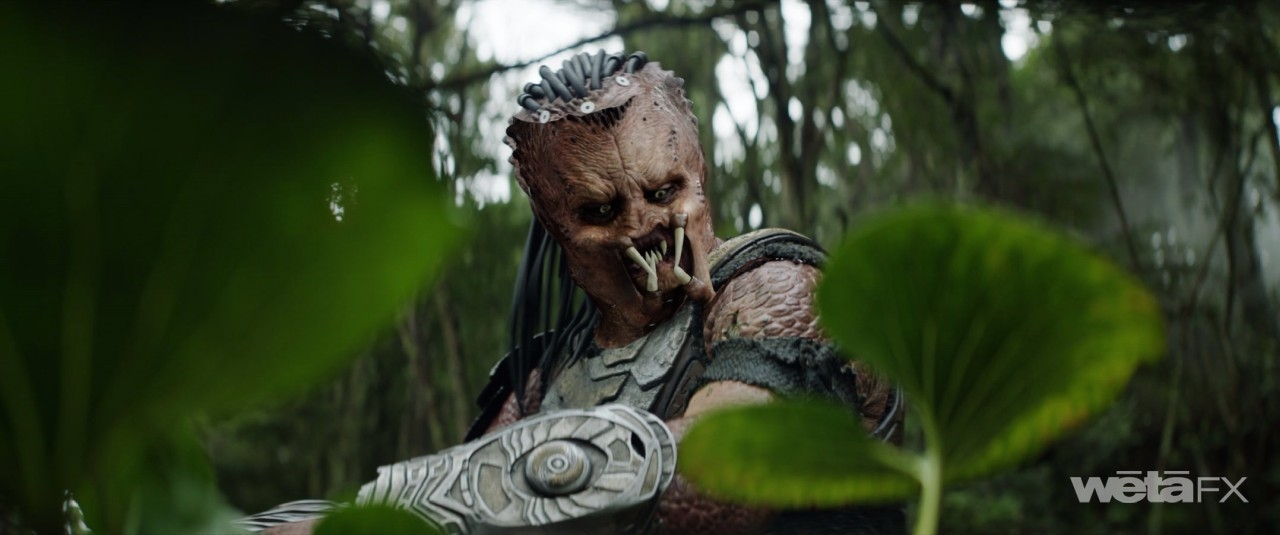
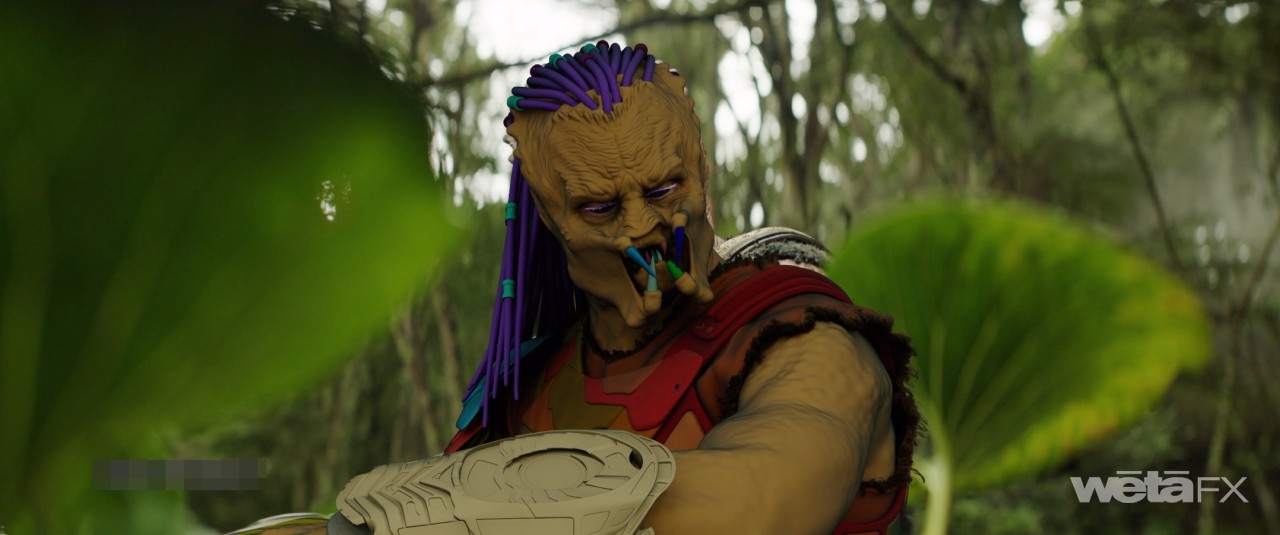
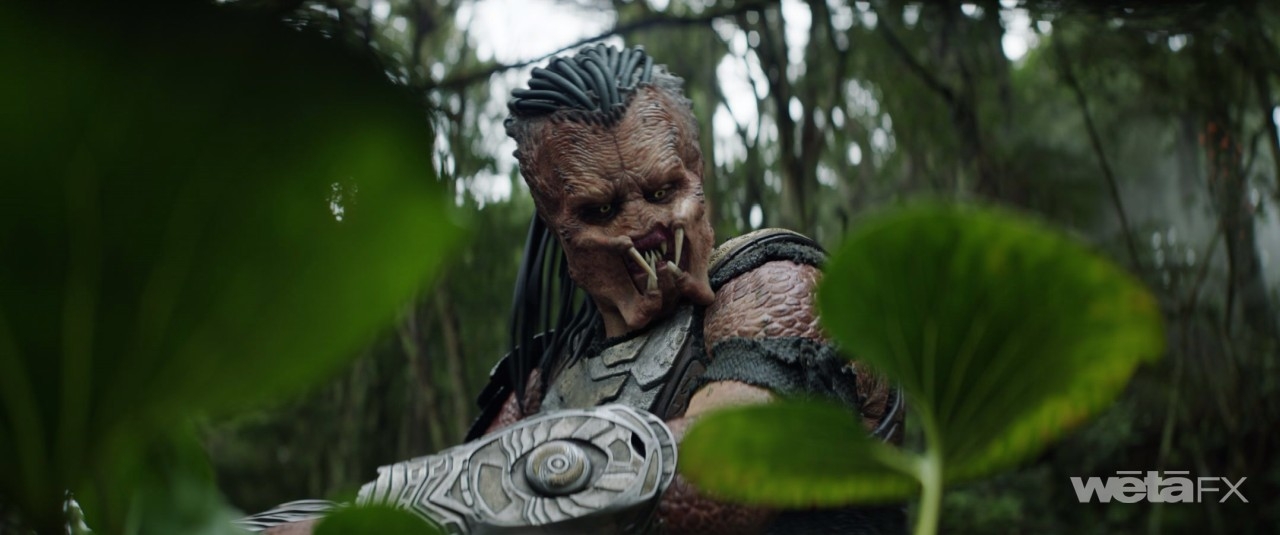
Rapley continues, “We had to find ways to puff the cheeks when he's doing something very strong and saying a word, or there's an alien sort of click in the Yautjia language. Just using what we had to convey a performance was a long journey in terms of how do we unlock that? In the early days, we went big on a lot of the screams and roars, and the mandibles were doing lots of things. Just bringing them back a bit more and actually doing sometimes even less with them or keeping it quite subtle was actually the answer in a lot of aspects.” Because not everything could be accomplished practically, a digital double was constructed. “We had to have essentially a CG asset, from head to toe, which needed to look realistic and had to support the photography it needed to fit in,” remarks Stopsack. “We predominantly looked at replacing Demetrius’ performance in his face. It was an incredibly strong creature design to start with, and we had a maquette for the design of this face and the mandibles.”
Paying attention to certain complexities of Dek’s facial design was key. “What characteristics and features would he have?” states Stopsack. “Whether he had a slightly hurt or scarred eye. Things that ultimately didn't end up being on the screen. But for us, as a visual effects house, we always take the strong foundation and ask how can we add to it? It comes down to the things that we know and learn in humans and over the course of our professional careers, like the intricacy of the subsurface in the skin and how the oil on the skin sort of has an effect on the highlights and how it focuses the light; that has an effect on how contrasty skin appears and how the pigmentation plays. We tried not only to match the maquette or the practical costume. We attempted to elevate it and give it the realism.”
The Kalisk, a giant monster with the ability to regenerate, proved a worthy adversary. “It was a very long journey for the Kalisk to be locked down and become the character that you see on screen now,” reveals Stopsack. “While there were initial concept designs that were done and delivered to us, our art department was also involved. There were characteristics and features reflected in the functionality of the body that were explored. For instance, the initial designs didn't have a lot of these tendrils that you see on the Kalisk. It was a much slicker, leaner appearance at first. Not only do you go through these creative iterations as you’re concepting and designing it, but there's also the form following function aspect. You have to make sense out of the context where you see the creature and how you engage with it; that informs retrospectively how the appearance needs to follow and what features and characteristics you see on the creature.” Eventually, the Kalisk design had to be modified once again to suit the captured footage and editorial requirements. “When the Kalisk first appears in the movie, coming out of this bushy forest and very foggy environment, you want that to leave an impression,” observes Stopsack. “It needed to feel right, and unique. It wanted to be intimidating. Many aspects were still in flux at that point.”
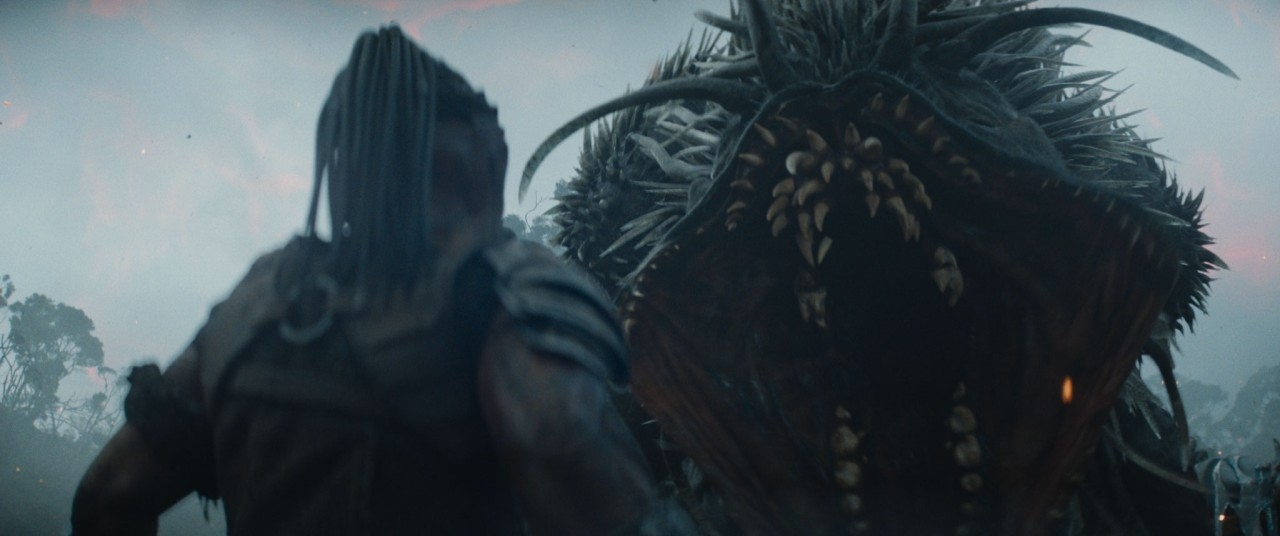
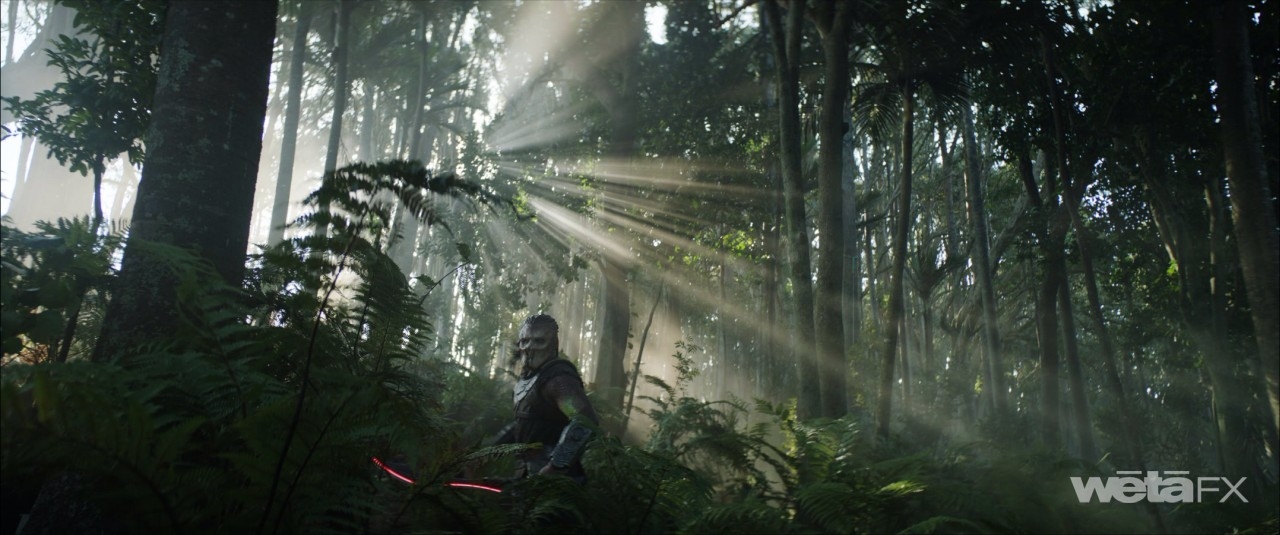
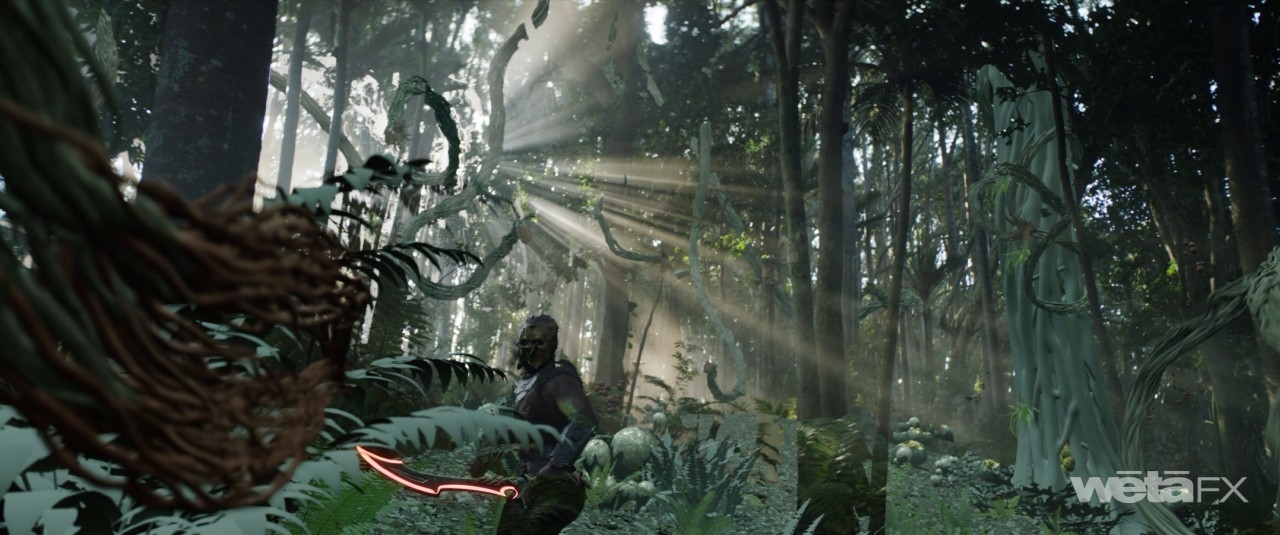
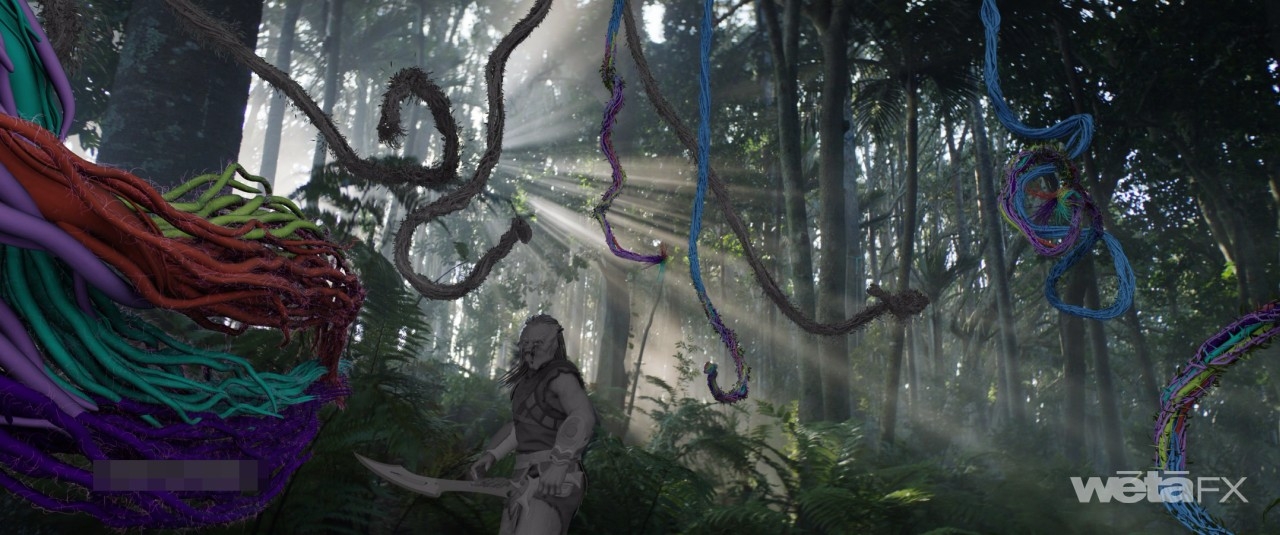
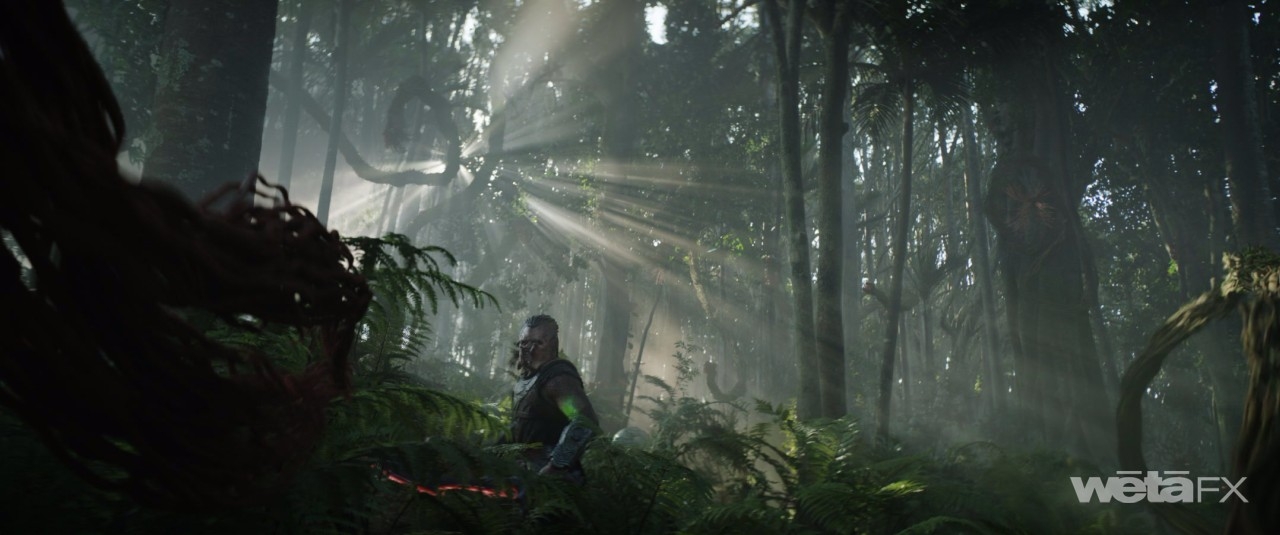
One of the highlights of the film is the seemingly endless array of lethal vegetation, in particular, the vicious elephant tree vines featured in the opening scene. “That was the first sequence we worked on, including postvis for the choreography,” states Rapley. “Trying to find the behavioral language of these vines was quite tricky. But then also how they moved as a pack. There was a certain rhythm to the sequence. They attacked and then there was a standoff when they all started to surround Dek like wolves and it developed from there. It is Dek’s first interaction with the planet, so they had to be aggressive and introduce you to ‘Hey, we're not going to mess around here. These things are going to attack you.’ But Dek is slicing them down the middle and there's sparks and embers going everywhere. The choreography was massively challenging, trying to find the right balance of when and where the vines attack and integrating them into New Zealand footage.”
The design of the vines evolved throughout production. “It was an iterative process,” remarks Stopsack. “How saturated are the red tips? How detailed and broken up? How many leaves? Ironically, even though we embarked on this and thought we knew what we were doing, it actually ended up taking longer to really figure out what we're doing simply because we were still finding our movie with Dan. But it was a fun sequence because of the practical photography shot and filmed here in New Zealand, so you had an incredibly nice backdrop to start with. However, then you begin orchestrating the elephant trees and you start realizing, ‘In order to make this work, you have to embed them in this environment.’ You begin having to do interaction with vegetation and bushes, which is challenging because then you begin adding to it or replacing it. But where do you stop? Where are your split lines? Plus, we had the requirement for alien-esque trees and mushrooms. There was a huge amount of augmentation on top, so it was quite involved. You watch the movie and it goes by in a blink of an eye!”
Previs was essential in mapping out the third act finale. “We flew up to Auckland and Dan had his pitch for Dek versus the power loader and the power loader versus the Kalisk,” recalls Rapley. “It would be a short, punchy sequence. We were referencing Jurassic Park and The Last of the Mohicans among other things. We batted ideas backwards and forwards. I came back to Wellington and with a small team we knocked out the sequence. It was difficult with the Kalisk and the power loader because they had abilities that we didn't fully understand at that time. The Kalisk can regenerate and there was a time when it had armor plating that would shoot out as well. Another time during the design, its arms would open up. The Kalisk was still being ironed out so we didn’t want to use all of these things in this fight. You've got a regeneration ability that seems very overpowered. How does a power loader fight that? Our answer was to stick a big saw blade through it and overpower the healing. Then the cryo-grenade comes into it again later. We developed that sequence then talked to Dan about it. He'd have ideas and we would iterate on them. Within five weeks we're shooting it in the middle of the night up on a farm just out of Auckland. It was a crazy time but super gratifying for me to see those previs shots being filmed, turned back to us as plates that we would add to and then do the final animation. Sheldon made it look beautiful. I am very proud of it.”
It was determined that Dek had to be part of the climatic fight. “Dan was insistent, and correctly so, that Dek needed to be involved as well in that fight,” reveals Rapley. “Finding moments where Dek could be ripping cables out of the back of the power loader or running along the arm and dislodging that cryo-grenade. How do we bring our hero into the fight? And finding moments to do that. When do we go full CG respecting the photography and the filming style, like when Dek first squares up against power loader? They did shoot part of that practically and it had a Steadicam style to it. Obviously, when you stick a big power loader there, the structure of the fight changes. Eventually that whole shot when Dek first engages with it was done in all CG. But we kept to that filming style to make it feel like it's all part of the same universe. Developing some of those shots, many of which were long, was a challenge.”
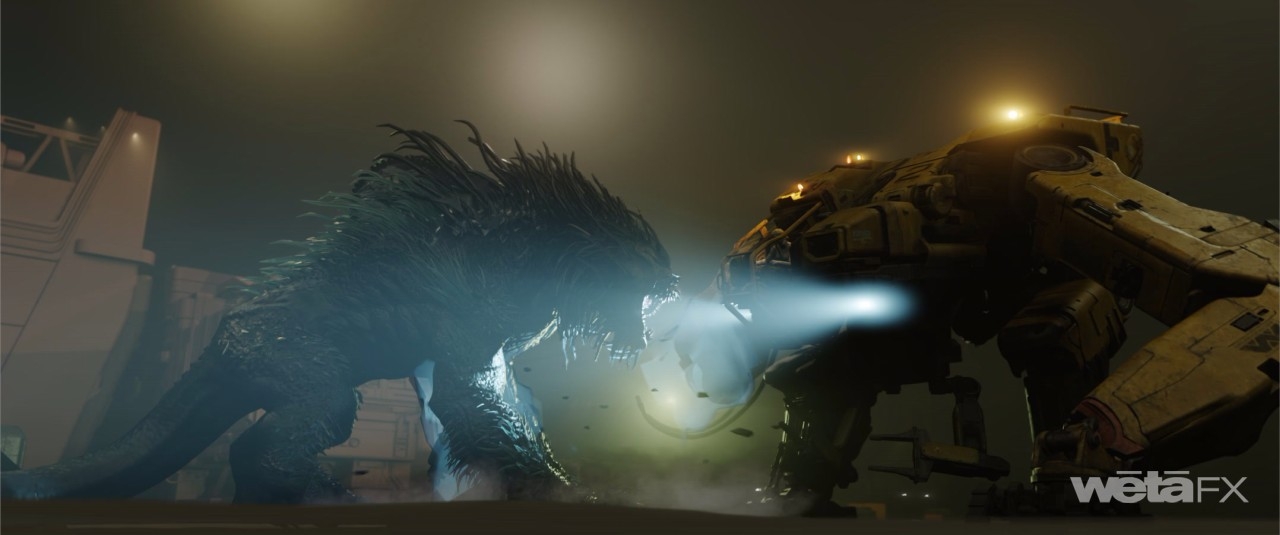
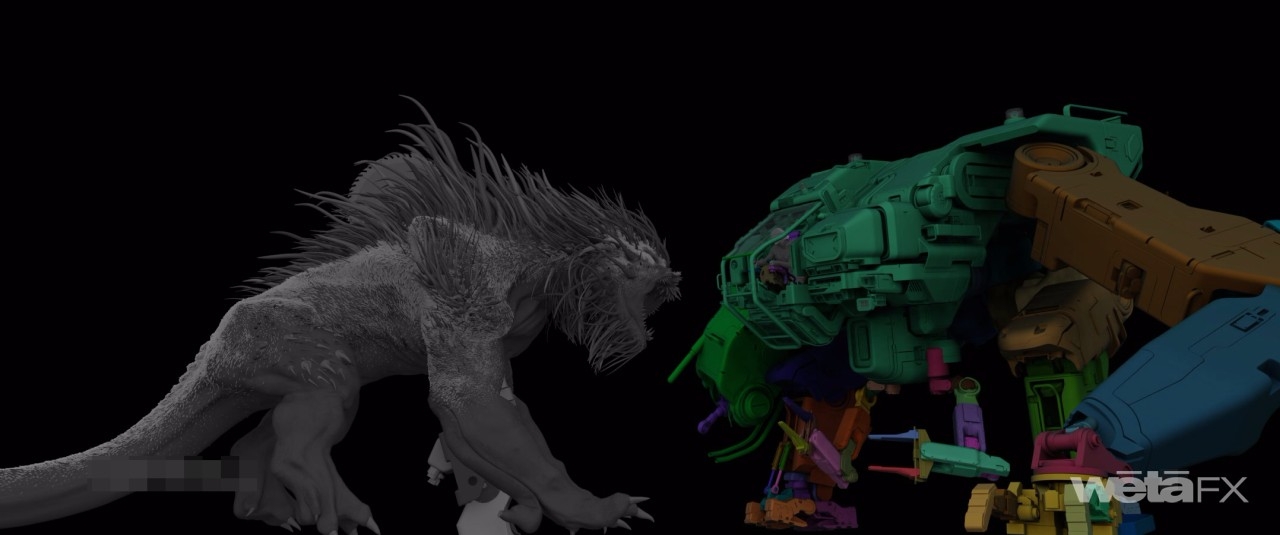
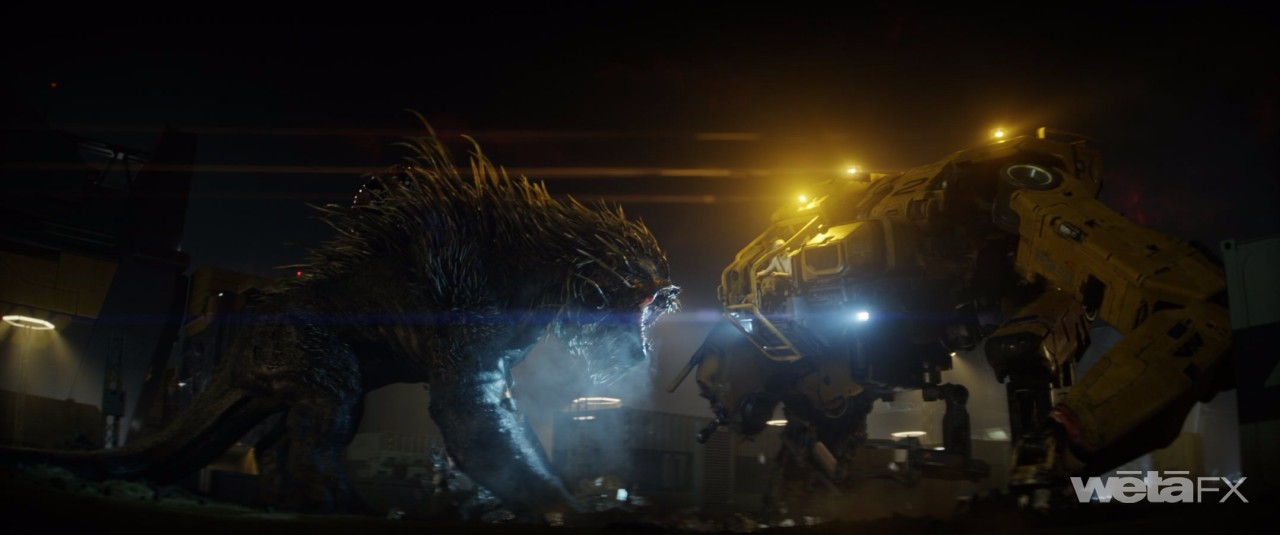
As much as Dek plays front and center in the film, so does the worldbuilding. “The Kalisk den, which seen is when Dek and Thia come to the destroyed Weyland-Yutani camp that’s flipped upside down, was plate-based photography for most parts,” states Stopsack. “But heavy augmentation was done because of all the destruction of the Kalisk and overgrowth of slime structures that you see. The Weyland-Yutani camp was a huge part of our work because it takes place where Dek is entering the camp with the squirt on his shoulder, which is lovingly called the organic shoulder cannon.”
A significant amount of time is spent in the camp for various sequences, such as the super power loader fight and the Kalisk swallowing Tessa before it explodes from a cryo-grenade she detonates inside the creature. The camp also had to be significantly larger than what was physically constructed. Orchestrating the action beats meant that the camp had to fulfill the needs of the fully CG shots while at the same time being an interchangeable asset with the plate photography. “The back end of the sequence when Thia, Dek and Bud have an emotional meet and greet all took place onstage with bluescreen and an even smaller footprint of plate photography,” explains Stopsack. “This was the big challenge because you have a sequence that starts off with night shoots, real lighting, everything is there and then all of a sudden you have stage photography. How do you make this work so that audience doesn’t become aware and call you out? It took a while to orchestrate not only the finish but also the transition from night to day. We also had a huge environment on our hands for the end sequence when Dek comes back to his father’s homestead on Yautjia Prime to finish off his journey, which effectively required an all-digital environment.”
The planet of Yautjia Prime is the setting for a number of family member battles. “Initially, there was one quick samurai movement by Dek and Father was down,” reveals Rapley. “But after test screenings, Dan was looking at it and was like, ‘This needs to be more epic. Fathers should be the ultimate badasses. Dek needs work to take him down.’ Extra stuntvis was done. They came down to Wellington, got in suits, and motion captured it. We were doing extra previs beats, which was awesome. Just opening it up, letting it breathe and seeing these two people come towards each other with the homestead, Dek’s ship landing, and the sandstorm that followed Dek turning on the ship's thrusters. We were putting ideas like that on the table and Sheldon brought it to life beautifully.”
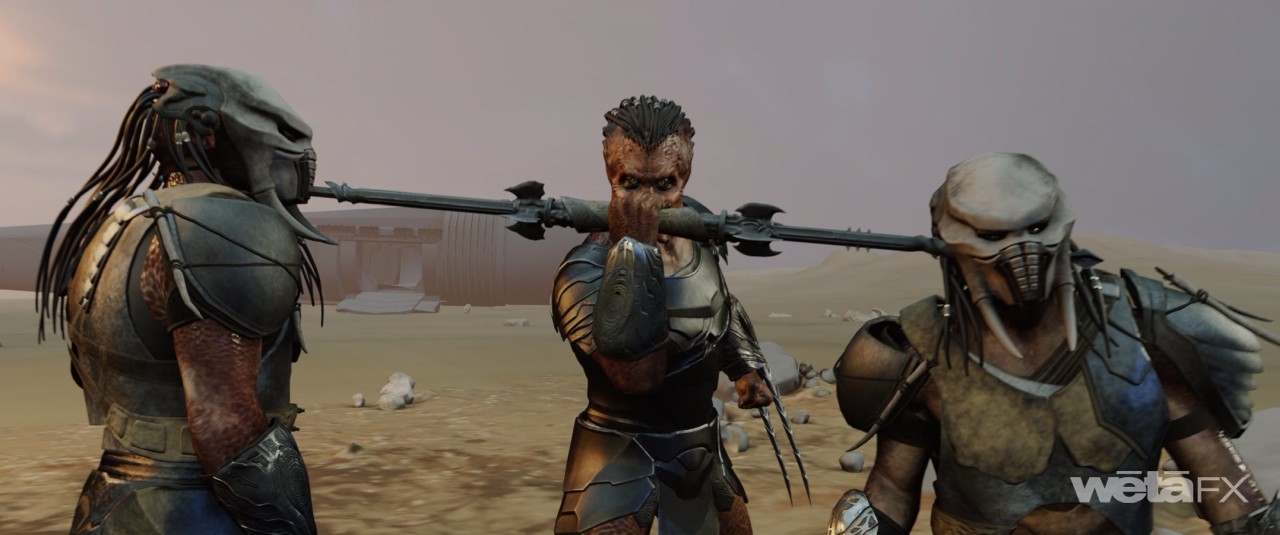
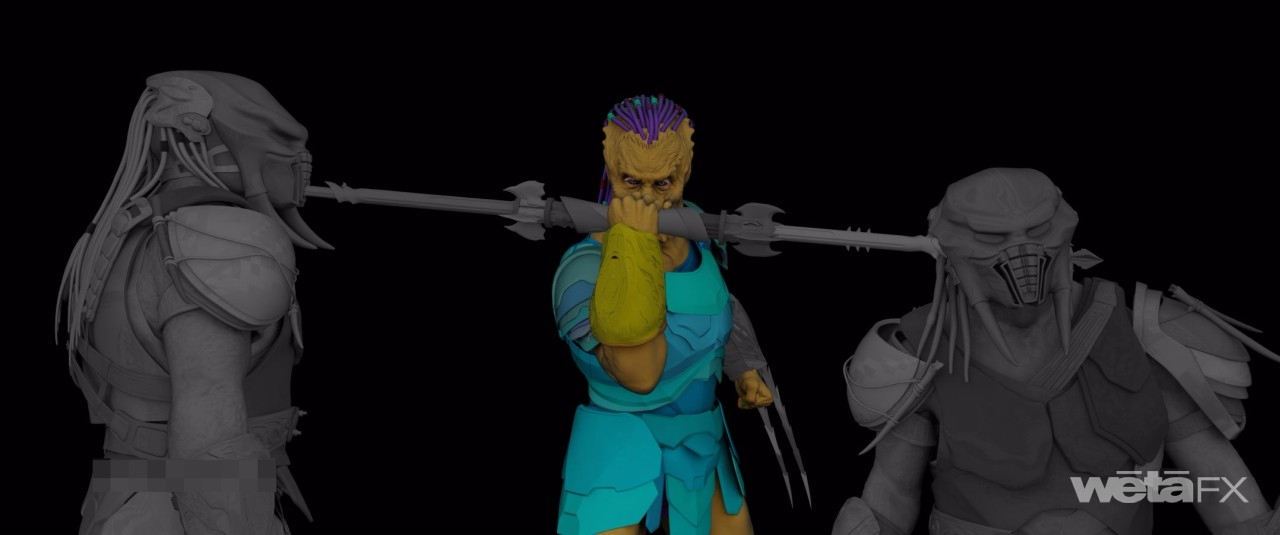
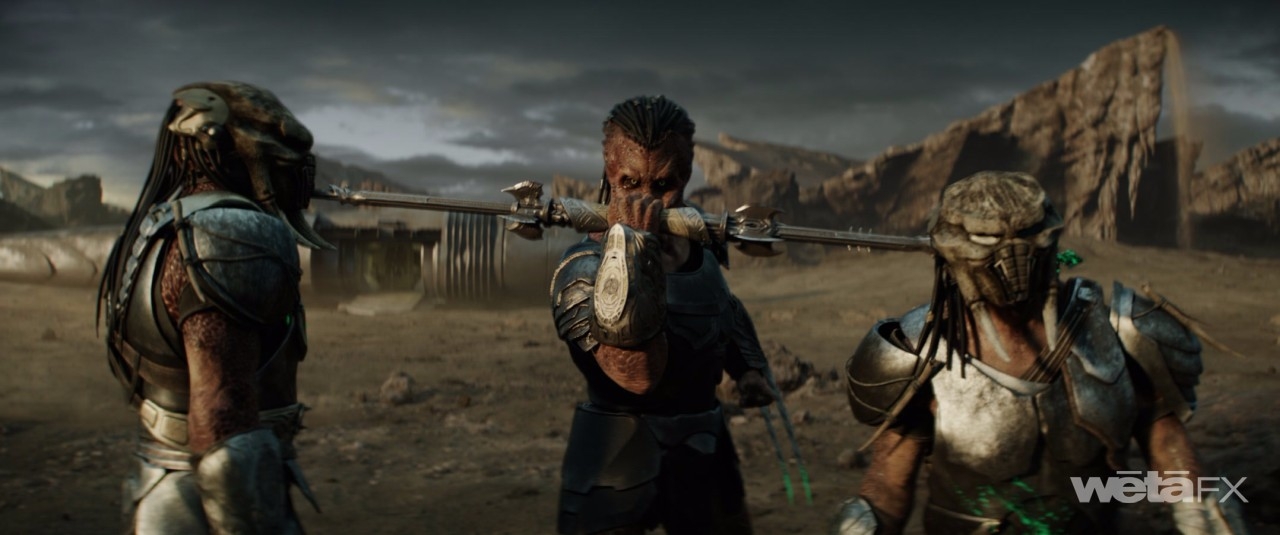
Stopsack adds, “While it was somewhat of a late addition to our body of work, it was something that represents this movie quite well because it got the love and the amount of effort it deserved. It grew into a much bigger sequence. What I particularly love about that is the sandstorm, because it ended up being very gritty and moody. I remember Dan talking about this being much denser and darker and not having a clear visibility on Father and Deck in those moments and make it ‘messy.’ It is very photographic. There's no clarity to this. It's just a very beautiful way of telling the story in that moment and supporting aesthetically what you were trying to convey.”

Trevor Hogg is a freelance video editor and writer best known for composing in-depth filmmaker and movie profiles for VFX Voice, Animation Magazine, and British Cinematographer.